How to Find Your Best LinkedIn Posting Time
Use weekday peak windows, industry benchmarks, and LinkedIn Analytics to test posting times and pair timing with active engagement for higher visibility.

Timing matters on LinkedIn. Posting when your audience is active boosts visibility and engagement, as LinkedIn’s algorithm favors early interactions. General trends show:
- Best Days: Weekdays, especially Tuesday and Wednesday.
- Peak Times: 8-9 AM, 10-11 AM, and lunchtime (12-2 PM).
- Avoid: Weekends, as engagement drops significantly.
However, your audience's habits depend on factors like industry, time zones, and work patterns. Use LinkedIn Analytics to test different posting times, monitor metrics like impressions and engagement rates, and refine your strategy. For example, a B2B company might see better results posting in the morning, while B2C brands may perform better during lunch or evening hours. Pair timing with active engagement - respond to comments and interact with others' posts for maximum impact.
The Best Time to Post on LinkedIn in 2025: 1 Million Posts Analyzed
General LinkedIn Posting Patterns
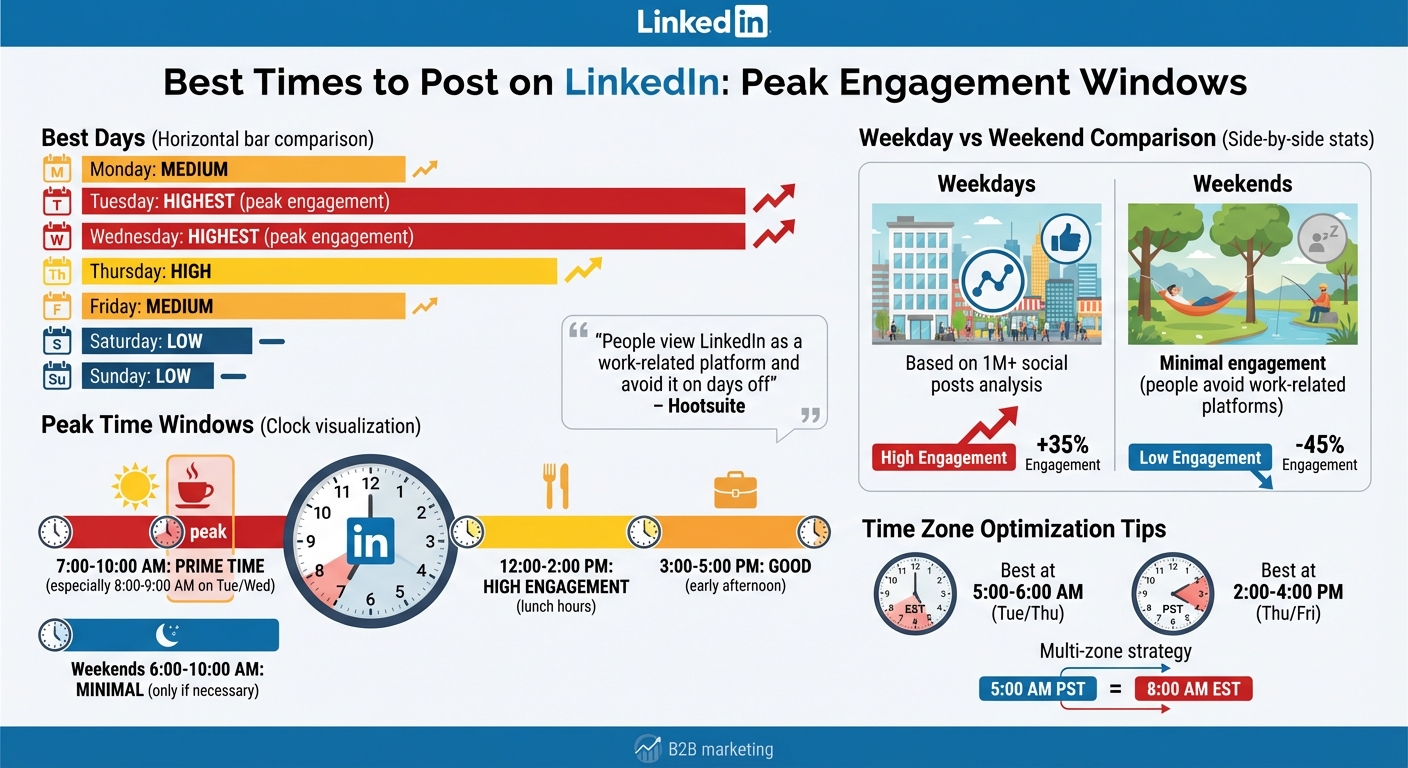
Best Times to Post on LinkedIn by Day and Hour
LinkedIn activity trends reveal that users are most engaged during business hours. Studies highlight these peak times, offering a helpful starting point for shaping your posting strategy. Of course, results will vary depending on your industry and audience, but understanding these patterns can help you align your content with when your audience is most active. Let’s break down the timeframes that typically see the best engagement.
Common High-Engagement Time Windows
Weekday mornings, especially between 7:00 AM and 10:00 AM, are prime posting hours as professionals kick off their day. Research shows that Tuesdays and Wednesdays between 8:00 and 9:00 AM often hit peak engagement levels [3]. Lunchtime slots, from 12:00 PM to 2:00 PM, and early afternoons, from 3:00 PM to 5:00 PM, also perform well [1]. These insights make it clear that LinkedIn engagement thrives during workdays, which brings us to an important comparison: weekdays versus weekends.
Weekdays vs. Weekends
When it comes to LinkedIn activity, weekdays vastly outperform weekends. According to Hootsuite’s analysis of over 1 million social posts, weekends are the least effective time to post on LinkedIn [6]. Similarly, SocialPilot’s study of 47,672 LinkedIn accounts found minimal engagement on weekends compared to weekdays [7].
"The lower engagement may be because people view LinkedIn as a work-related social media platform and something to avoid on days off." - Hootsuite [6]
If you must post on weekends, early mornings - between 6:00 AM and 10:00 AM on Saturdays and Sundays - might catch some activity [3][6]. However, engagement will still be much lower than during the workweek, as professionals often shift their focus to personal social platforms over the weekend [7].
How to Identify Your Audience's Behavior
General trends can provide a starting point, but understanding your audience's specific behavior is where the real value lies. Different industries operate on unique schedules, and their LinkedIn activity reflects these patterns. By digging into these nuances, you can move past generic advice and pinpoint the best times to engage your particular audience.
Industry-Specific Patterns
Each industry has its own rhythm when it comes to LinkedIn engagement. For example, professionals in construction, mining, and manufacturing are most active during shift changes on particular weekdays [6]. On the other hand, those in dining, hospitality, and tourism tend to engage most on Wednesdays at 12:00 PM, likely during a break between service periods [6]. The education sector shows spikes in activity on Wednesdays at 9:00 AM, Fridays between 11:00 AM and 1:00 PM, and at various times from Monday to Thursday between 10:00 AM and 3:00 PM [6].
For B2B companies, engagement typically peaks during weekday mornings and late afternoons, especially on Tuesday, Wednesday, and Thursday mornings when professionals are actively collaborating and planning [8]. In contrast, B2C brands often see better results by targeting lunchtime (12:00 to 1:00 PM EST) or evening hours (7:00 to 9:00 PM EST), when consumers are more likely to browse LinkedIn casually [8].
To make the most of your LinkedIn strategy, align your posting schedule with these industry-specific habits. Then, take it a step further by adjusting for your audience’s location and time zones.
Adjusting for Time Zones and Location
Once you’ve accounted for industry habits, geography becomes the next critical factor. With LinkedIn’s massive global user base - over 1 billion members across 200 countries and regions [3] - time zones play a big role in optimizing your posting strategy. For instance, a lunchtime post in New York (12:00 PM EST) aligns with dinnertime in London (5:00 PM GMT) [2]. If your audience is primarily in the U.S., consider that a 9:00 AM PST post can effectively reach both West Coast early risers and East Coast professionals starting their day [6].
To cover multiple U.S. time zones, aim for overlapping windows. For example, posting at 5:00 AM PST can catch early risers on the West Coast and morning activity on the East Coast [6]. If your focus is on a specific region, tailor your schedule to their local times. Eastern Standard Time sees the most engagement at 5:00 AM and 6:00 AM on Tuesdays and Thursdays, while Pacific Standard Time performs best between 2:00 and 4:00 PM on Thursdays and Fridays [6].
"As I always do in these articles on the best time to post on social media, I advise experimenting with your posting schedule as part of your LinkedIn marketing strategy, then digging into your social media analytics to uncover your unique best time to post and make the most of the LinkedIn algorithm." - Kirsti Lang, Senior Content Writer, Buffer [2][1]
Use these industry benchmarks and time zone insights as a foundation for your strategy, but keep in mind that there’s no one-size-fits-all solution [2].
How to Use LinkedIn Analytics to Test and Improve
Once you've grasped your industry's trends and time zones, it's time to put those insights to work. LinkedIn's built-in analytics can guide you in figuring out what resonates with your audience. The key? Testing, tracking, and tweaking your strategy based on real-world performance.
Setting Up a Testing Schedule
Using what you know about industry trends and audience behavior, design a structured testing plan that runs for two to four weeks. Experiment with different posting times to see what sticks. For instance, you could try posting on Tuesday mornings at 8:00 AM, Wednesday afternoons at 2:00 PM, and Thursday evenings at 7:00 PM.
Trish Riswick, Social Media Team Lead at Hootsuite, shared an interesting observation: posting on Mondays and Fridays drove the best results for her team. She also noticed that when she missed a noon post and instead published at 2:00 PM, engagement spiked throughout the week. Testing like this can help you uncover what works best for your audience.
Monitoring Engagement Metrics
Keep a close eye on key performance indicators like impressions, reactions, comments, shares, and clicks for each post. Engagement rate is particularly important - on LinkedIn, a 2% engagement rate is considered strong [9]. Use tools like the "When your followers are on LinkedIn" heatmap to pinpoint when your audience is most active. To spot trends, document each post's topic, timing, and performance metrics in a spreadsheet.
Adjusting Your Posting Strategy
Once your testing phase wraps up, dive into the data to find your most effective posting times. Look for patterns instead of focusing on one-off successes. For example, a mid-sized B2B software company found its technical audience was most active between 8:00 and 10:00 AM on weekdays. By concentrating their posts during this window - specifically from Tuesday to Thursday - and engaging within the first 30 minutes of posting, they saw impressive results: a 78% boost in impressions per post, a 142% jump in engagement rate, 35% growth in followers, and a 22% increase in LinkedIn-driven website traffic over 90 days [5].
Once you've nailed down your best posting times, make the most of them. But timing alone won't cut it - pair your posts with active engagement to maximize results. Regularly review your metrics to ensure your strategy stays effective, and use these insights to refine not just your timing but your overall approach to audience interaction.
Pairing Timing with Active Engagement
Finding the best time to post is just one piece of the puzzle. To truly maximize your reach, you need to pair smart timing with active engagement. LinkedIn’s algorithm favors posts that drive interaction, so creating opportunities for engagement is key.
As Kirsti Lang points out, engaging with others at the right time can amplify your post’s reach. This means that being active both before and after you post can significantly boost your visibility.
Engaging Around Your Posting Time
Before you publish your content, take a moment to interact with others in your niche. Like, comment on, and share posts that align with your interests or expertise. This not only increases your activity on the platform but also makes your profile more visible in your network’s feed, setting the stage for your upcoming post to be noticed.
Once your post is live, don’t disappear. Stay engaged by responding to comments quickly, continuing to interact with others’ content, and keeping the conversation alive.
"Networking isn't just about messaging. Join relevant groups and conversations, comment on posts, share thoughtful content. This builds your visibility and credibility, making your outreach more genuine and valued" [4].
To keep your engagement consistent, you might try strategies like the "3-2-1" or "4-1-1" rules. These methods help you maintain a steady presence without overwhelming your audience.
Using Tools to Support Your Engagement
If managing engagement manually feels like too much, automation tools can help. Posting at the right times while staying actively engaged can be time-consuming, but tools like EngageKit make it easier to stay consistent.
EngageKit allows you to create targeted lists, discover niche topics, and approve interactions before they’re posted. This approach saves time while ensuring your engagement is meaningful and relevant. Consistently connecting with the right people increases the chances that your posts will get the attention they deserve. By combining these targeted interactions with your posting schedule, you can reinforce the strategies discussed earlier and build lasting connections.
Conclusion
Figuring out the best time to post on LinkedIn takes a mix of analysis, experimentation, and staying active on the platform. A good starting point? Weekdays during business hours - especially Tuesdays and Wednesdays between 8:00–9:00 AM - often see strong engagement across many industries. But these are just general guidelines.
To fine-tune your strategy, dive into LinkedIn Analytics to discover when your audience is most active. Pay attention to factors like industry, job roles, and time zones. For instance, if your audience spans the U.S., posting at 8:00 AM PST can hit West Coast professionals starting their day and East Coast users scrolling mid-morning. Use these insights to adjust your approach based on what works for your specific audience.
Experiment with different posting times and track how your content performs. Keep an eye on metrics like likes, comments, and shares to see what clicks with your network. But remember, timing alone isn’t enough. LinkedIn’s algorithm rewards posts that spark quick, meaningful engagement. So, pair your schedule with content that encourages interaction.
Stay adaptable and focus on creating posts that connect with your audience. Combine smart timing with authentic engagement to boost your visibility on LinkedIn. If you need extra help, tools like EngageKit can provide real-time insights and help you manage your LinkedIn activity more effectively.
FAQs
What’s the best way to figure out when to post on LinkedIn for my industry?
To figure out the best times to post on LinkedIn, start by diving into your audience's activity and engagement trends. Experiment with different posting times over several weeks and use LinkedIn’s analytics to see which time slots generate the most engagement. Weekdays from 8–11 a.m. and around lunchtime (12–1 p.m.) are often effective, but your ideal timing will depend on your audience and industry.
If you want a more precise strategy, tools like EngageKit can help you connect with your audience and fine-tune your posting schedule. By focusing on genuine interactions and monitoring engagement patterns, you’ll be able to maximize your content’s reach and impact.
How do time zones affect the best times to post on LinkedIn?
Time zones are a key factor in figuring out the best times to post on LinkedIn. By matching your posting schedule to the local time of your target audience, you can boost the likelihood that your content gets noticed and interacted with.
Think about where your audience is based and aim to post during their busiest times - like early mornings, lunch breaks, or late afternoons. These are the moments when professionals are most likely scrolling through their feeds, giving your posts a better shot at catching their attention and driving engagement.
How can I use LinkedIn Analytics to optimize my posting schedule?
LinkedIn Analytics is a powerful tool for figuring out the best times to post. It shows you when your audience is most active, making it easier to time your content for maximum visibility and engagement. By aligning your posts with these peak activity periods, you can boost interaction and reach.
Beyond timing, LinkedIn Analytics offers valuable insights into how your posts are performing. This data helps you fine-tune your content strategy by highlighting the topics and formats that resonate most with your audience. With this information, you can create posts that leave a stronger impression and drive better results.