How LinkedIn Groups Drive Personal Branding
Use LinkedIn Groups to boost visibility, build credibility, and connect with professionals. Join active groups, optimize your profile, and engage regularly.

Want to stand out professionally? LinkedIn Groups can help you build your personal brand.
Here’s how:
- Targeted Networking: Connect with specific industry professionals.
- Credibility Boost: Share insights to position yourself as an expert.
- Expanded Reach: Engage with active communities for visibility.
- Profile Optimization: A strong LinkedIn profile amplifies your group interactions.
Key Tips:
- Focus on 3–5 active, relevant groups.
- Set clear goals, like connecting with 10 professionals or posting weekly.
- Use tools like EngageKit to manage and scale your engagement.
LinkedIn Groups aren’t just about joining - they’re about contributing meaningfully and aligning your efforts with career goals. Ready to take your professional visibility to the next level?
Finding and Joining the Right LinkedIn Groups
How to Identify Groups in Your Industry
Start by defining your niche and goals. Think about your strengths and the specific professionals you want to connect with. For example, instead of targeting broad categories like "content marketing", focus on something more specific, like "SEO-driven content marketing for B2B SaaS companies." This clarity will help you find the right communities.
Use LinkedIn's search bar to discover groups by typing in keywords related to your industry, job role, or the topics your ideal audience cares about. You can also check the profiles of industry leaders or your existing clients to uncover active groups that might not show up in a basic search.
Once you’ve identified a few groups, take time to evaluate their activity and engagement levels to ensure they’re worth joining.
How to Evaluate Group Activity and Engagement
Don’t let large member counts fool you. Sometimes, smaller groups with active discussions can offer better opportunities to connect meaningfully. A good benchmark for a thriving group is about 20% active participation [2].
Check how often discussions are posted - weekly is a minimum, but daily is even better. However, quantity isn’t everything. Look at the quality of conversations. Are members asking thoughtful questions, sharing detailed insights, or simply dropping promotional links? A group with fewer posts but high-quality engagement - measured by likes and comments - can be more beneficial.
"Spam is the top reason people leave groups." - LinkedIn [3]
Good moderation is key. Look for signs that the group actively removes spam posts and enforces clear rules. Private groups often have better moderation than open ones, so review the group’s description and guidelines to ensure it aligns with your professional goals.
After assessing group activity, set clear participation goals to make the most of your time.
Setting Goals When Joining Groups
Joining the right groups can boost your credibility and strengthen your personal brand. Instead of spreading yourself thin, focus on three to five high-quality groups that align closely with your target audience. Overcommitting to too many groups can make it harder to build meaningful connections.
Set SMART (Specific, Measurable, Achievable, Relevant, Time-bound) goals for your participation. For instance, instead of saying, "I want to network more", aim for something like, "Connect with 10 industry leaders in an AI in Healthcare group by the end of Q1" or "Post two insightful comments per week in a Digital Marketing Innovators group to showcase expertise" [6].
"I've documented plans, I've set SMART goals, and I've tracked towards those goals, and I've seen the momentum build in a significant way as a result." - Tyler Norman, Sr. Program Manager, Business Operations, Scholastic Inc. [6]
Make sure your group involvement aligns with your bigger career objectives, whether that’s expanding your network, demonstrating expertise, or staying updated on industry trends. Being active in the right groups can lead to valuable opportunities, from collaborations to client work.
How Do You Use LinkedIn Groups To Build Your Personal Brand? - Social Media Business Playbook
Preparing Your LinkedIn Profile for Group Engagement
A well-crafted LinkedIn profile is the foundation of successful group interactions. It not only highlights your expertise but also helps convert casual views into meaningful professional connections. Before diving into LinkedIn groups, take the time to fine-tune your profile. With an optimized presence, you’ll be ready to make a strong impression in group discussions.
Improving Your Profile for Visibility
Your headline is often the first thing people notice in group discussions. Instead of just listing your job title, use this space to communicate the value you bring. For example, in March 2025, Column Team suggested transforming a generic headline like "CEO | Startup Founder | Investor" into something more descriptive: "Helping SaaS brands 2x demand & land strategic partnerships | Founder @ X" [7]. This approach immediately tells others who you help and the results you deliver.
To increase your profile's visibility, integrate industry-specific keywords throughout. Sociabble, in November 2025, highlighted a strong example: "Helping brands grow through employee advocacy | Communication Strategist & Senior Manager @Sociabble" [8]. Keywords like these make it easier for others in your field to find you.
Your Featured section is another powerful tool. Use it to display case studies, speaking engagements, or testimonials that validate your expertise [7][8]. When group members check out your profile after reading your comments, this section reinforces your credibility.
Once you’ve optimized these elements, focus on completing your profile to further build trust.
Building Trust Through Profile Completeness
A professional photo can make a huge difference. Profiles with clear, industry-appropriate headshots see up to 21 times more views and 9 times more connection requests [4][9]. It’s a simple yet effective way to boost engagement.
Completing all sections of your profile is equally important. For instance, including your industry can multiply profile views by up to 9 times and increase recruiter discoveries by 38 times. Adding your location can boost views by 19 times [10]. When filling out your experience, focus on measurable achievements rather than just listing responsibilities. Sociabble shared some great examples in November 2025, such as: "Increased engagement by 32%", "Launched new onboarding initiative for 500 employees", and "Improved content reach by 60% through advocacy" [8].
Recommendations are another key element of trust. Instead of vague endorsements, aim for specific testimonials. For example: "Working with [Your Name] transformed our LinkedIn strategy, yielding a 40% increase in inbound partnership opportunities within 3 months" [7]. These detailed recommendations demonstrate your impact and build credibility with potential connections.
How to Engage in LinkedIn Group Discussions
Once your LinkedIn profile is polished, it's time to make the most of group discussions. These interactions are a powerful way to amplify your personal brand while fostering meaningful professional relationships.
Adding Value Through Comments
Your comments on LinkedIn hold more power than you might realize. With the introduction of comment impression counts, LinkedIn has made it clear that well-thought-out comments can enhance your visibility [5]. This is an excellent opportunity to strengthen your personal brand.
Focus on providing genuine insights rather than generic responses. When engaging with a post, aim to share a fresh perspective, answer questions, or offer helpful resources. This not only grabs the attention of the original poster but also resonates with their network.
For example, if someone raises a question related to your expertise, take the time to provide a clear and actionable response. If you come across a post that offers valuable insights, acknowledge it and contribute by sharing your own relevant experiences. These thoughtful interactions can leave a lasting impression.
Sharing Content That Demonstrates Expertise
The content you share in LinkedIn groups should showcase your expertise and address real challenges faced by your audience. According to LinkedIn data, 91% of executives prefer the platform when searching for quality content [11]. This means your posts have the potential to reach a highly engaged audience if they strike the right chord.
Share a mix of content types to keep things dynamic. For instance, you could post actionable tips, share case studies, or create polls that invite feedback. Document carousels are particularly effective - LinkedIn reports they can triple post clicks [5]. Use them to share frameworks or step-by-step guides in an engaging format.
Curated content is another valuable tool. When you come across articles or insights that align with your audience's interests, share them with added context. Explain why the content is relevant and how it can help, positioning yourself as a reliable resource. This thoughtful approach can deepen engagement and open the door to stronger connections.
Building Relationships Through Regular Participation
Consistency is the secret to building trust and recognition within LinkedIn groups. Regularly participating in discussions helps you stay top of mind with key members. To ensure you're engaging with the right people, consider creating a list of high-priority group members to interact with consistently.
Building relationships thrives on reciprocity. When you engage with others' posts thoughtfully, they're more likely to return the favor. Dedicate time each week to join discussions, reply to comments, and connect with others. These small but meaningful interactions can significantly expand your influence.
Take it a step further by nurturing these connections. A simple thank-you message after connecting, sharing a relevant resource, or offering an introduction can transform casual interactions into a solid professional network. Over time, these efforts can lead to referrals, collaborations, and new opportunities.
Scaling Engagement with EngageKit
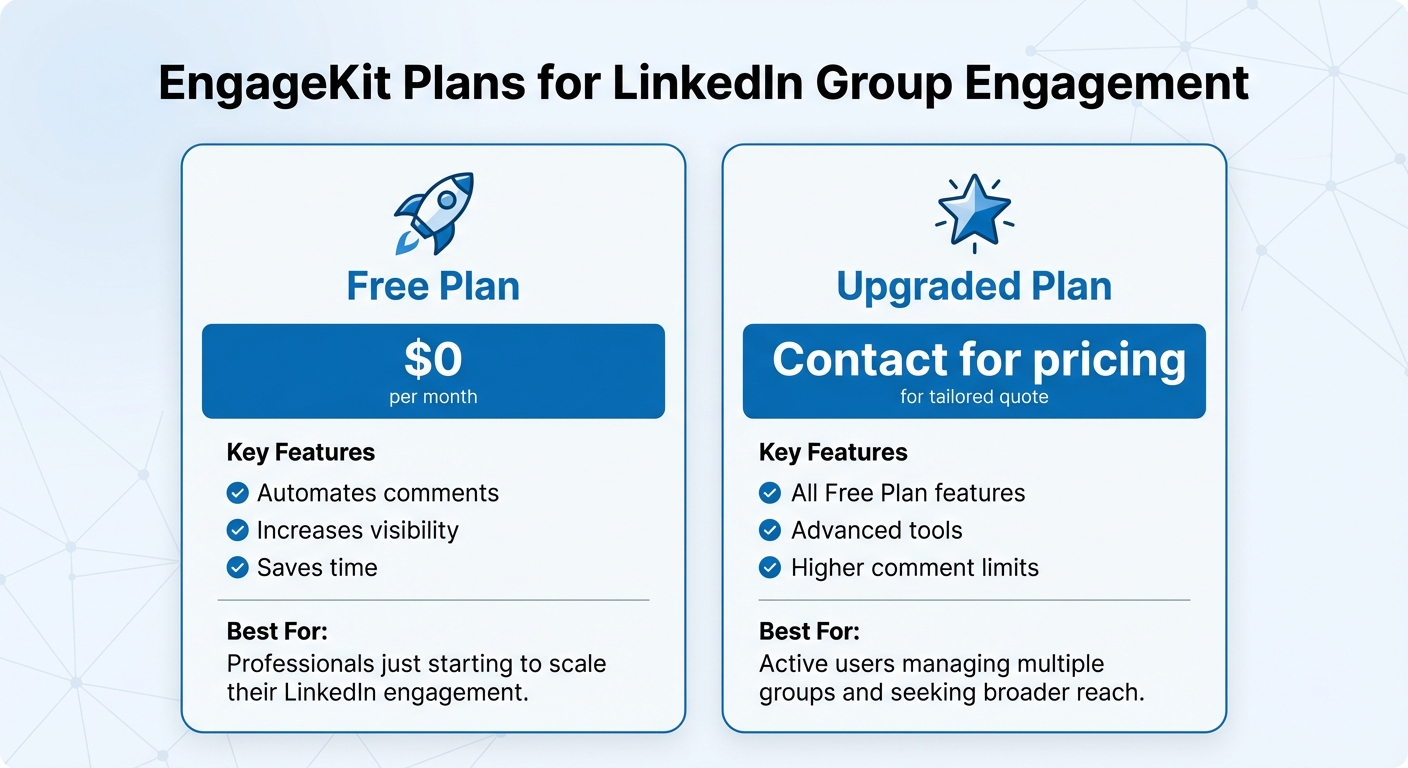
EngageKit LinkedIn Group Engagement Plans Comparison
Participating actively in LinkedIn groups can be a game-changer, but keeping up with consistent, meaningful interactions takes effort. That’s where EngageKit comes in, offering a streamlined way to manage and grow your engagement without losing the personal touch.
How EngageKit Enhances Group Interactions
EngageKit is designed to help you maintain genuine, impactful interactions while scaling your efforts. Its human-guided process ensures you have full control over every comment and interaction, letting you stay true to your personal brand.
The tool also allows you to stay organized by using targeted lists and topic searches tailored to your industry. This makes it easy to pinpoint key group members and focus on conversations that align with your goals. By zeroing in on the right discussions, you can build stronger, more meaningful connections.
This method doesn’t just improve your visibility - it also boosts engagement with your content. Consistent participation increases response rates, setting the stage for deeper professional relationships that go beyond LinkedIn group discussions.
EngageKit Plans for Group Engagement
EngageKit offers flexible plans to suit different levels of engagement needs:
| Plan | Price | Key Features | Best For |
|---|---|---|---|
| Free Plan | $0 | Automates comments, increases visibility, saves time | Professionals just starting to scale their LinkedIn engagement |
| Upgraded Plan | Contact for pricing | Includes all Free Plan features + advanced tools, higher comment limits | Active users managing multiple groups and seeking broader reach |
The Free Plan is perfect for those dipping their toes into LinkedIn group engagement, offering basic automation to save time. For those looking to take it up a notch, the Upgraded Plan provides advanced features and higher comment limits, ideal for professionals aiming to expand their influence across multiple groups.
Measuring and Improving Your LinkedIn Group Strategy
Metrics to Track
Pay attention to these key metrics to assess and refine your LinkedIn Group efforts:
- Profile views: A noticeable increase in profile views often mirrors your activity within LinkedIn Groups. Sharing valuable comments or insights can naturally draw more attention to your profile [15].
- Connection requests: These are often more telling than follower counts. When group interactions lead to quality connections, it's a sign you're reaching professionals who align with your personal branding goals. Similarly, keep an eye on engagement rates - comments and shares on your posts indicate whether your group participation is sparking meaningful conversations [12].
- Search appearances: This metric shows which keywords are driving people to your profile. It’s a great way to fine-tune both your profile and group contributions to include industry-relevant terms [15].
- Post performance by content type: Different types of posts perform differently. For example, in 2025, multi-image posts average a 6.60% engagement rate, native documents achieve 6.10%, and videos reach 5.60% [13]. These insights can help you align your group engagement with the formats that resonate most.
Adjusting Your Strategy Over Time
Using the metrics you’re tracking, make ongoing adjustments to improve your results. A monthly review of your performance can help you spot trends early and adapt quickly [14]. If certain topics or post types consistently outperform others, focus more on those.
Every quarter, audit your group memberships. Exit groups that are inactive or provide little value, and invest your time in communities that drive profile visits, connection requests, and engaging discussions [5].
If your posts in a group aren’t gaining traction, be ready to pivot. Try experimenting with different content formats or posting at new times. For instance, carousels can boost post clicks by three times [5], while native videos with a strong opening in the first three seconds can grab attention effectively [13]. Use these experiments to refine your approach and prioritize content that delivers the best results.
Conclusion and Key Takeaways
Summary of Strategies
LinkedIn Groups offer a powerful way to build meaningful relationships while strengthening your personal brand. They help expand your network, increase visibility, and establish credibility in your field [16][1][4]. By sharing insights on industry trends and engaging consistently, you position yourself as a trusted voice and a thought leader [16][1].
This guide suggests a focused approach: identify 2–3 groups that align with your niche and are frequented by potential clients or strategic partners [1]. Make sure your LinkedIn profile reflects your expertise and inspires trust, then actively contribute by sharing valuable insights and recognizing others' contributions. Sharing thought leadership content and engaging authentically will demonstrate your commitment to your field [4]. Tools like EngageKit can simplify this process by helping you track connections and maintain genuine interactions within your niche. Combining a polished profile with active group participation ensures your branding efforts remain impactful and consistent.
Next Steps
Now it’s time to put these strategies into practice. Start by reviewing your current group memberships to identify where your target audience is most active. Update your profile to highlight your expertise and focus on offering value rather than promoting yourself [17]. Track metrics like profile views, connection requests, and engagement rates each month, and adjust your approach based on these results. Regular, meaningful participation in your groups will help you grow your professional influence and strengthen your network [1].
FAQs
How do I find LinkedIn Groups that are best for my industry?
To discover the best LinkedIn Groups for your industry, begin by searching for keywords tied to your profession or niche. Focus on groups that show consistent activity and are well-managed, as these often encourage richer, more valuable discussions. Before hitting the "Join" button, take a moment to read the group's description, rules, and recent posts. This will help you determine if the group aligns with your professional interests and goals. Aim for spaces where members actively participate and exchange ideas relevant to your field.
What are the best ways to participate in LinkedIn Group discussions effectively?
To get the best out of LinkedIn Group discussions, prioritize contributing value. Share useful insights, pose thoughtful questions, and actively engage with others' posts in a way that fosters meaningful interaction. Consistency is key - participate regularly while adhering to group rules and keeping a professional tone.
Steer clear of overly promotional posts, spam, or heated arguments. Instead, focus on creating authentic connections and adding constructive input to discussions. This approach not only boosts your visibility but also helps you establish a stronger personal presence within your industry.
How can an optimized LinkedIn profile improve my interactions in Groups?
An updated and polished LinkedIn profile helps others in your Groups identify your expertise and view your input as trustworthy. By highlighting your skills, accomplishments, and professional persona, you can position yourself as a knowledgeable and engaging member.
When your profile clearly communicates your niche and professional objectives, it opens the door to meaningful connections and increases your presence within industry-focused communities. This doesn’t just improve the quality of group interactions - it also steadily builds your personal brand.