How to Generate Leads on LinkedIn for Real Growth

Think of your LinkedIn profile not as a resume, but as a dedicated landing page for your ideal client. It's the first—and often most important—step in generating leads. A strategically built profile works for you 24/7, warming up prospects before you even send a single message.
Build Your Profile Into a Lead Generation Machine
Before you even think about outreach or content, you have to get your own house in order. Your LinkedIn profile is the foundation of everything that follows. When someone lands on your page—whether from a search, a comment you left, or a connection request—they need to know three things instantly: who you serve, what problem you solve, and why they should trust you.
If your profile doesn't nail this, all your other efforts will be less effective.
This is especially true in the B2B world. There's a reason nearly 89% of B2B marketers lean on LinkedIn for lead generation. The platform is a powerhouse, proving to be 277% more effective for generating leads than Facebook and X (formerly Twitter). If you want to dive deeper, you can explore more data about B2B marketing effectiveness to see why it's such an indispensable tool.
This simple flow shows how the key pieces of your profile work together to attract the right people.
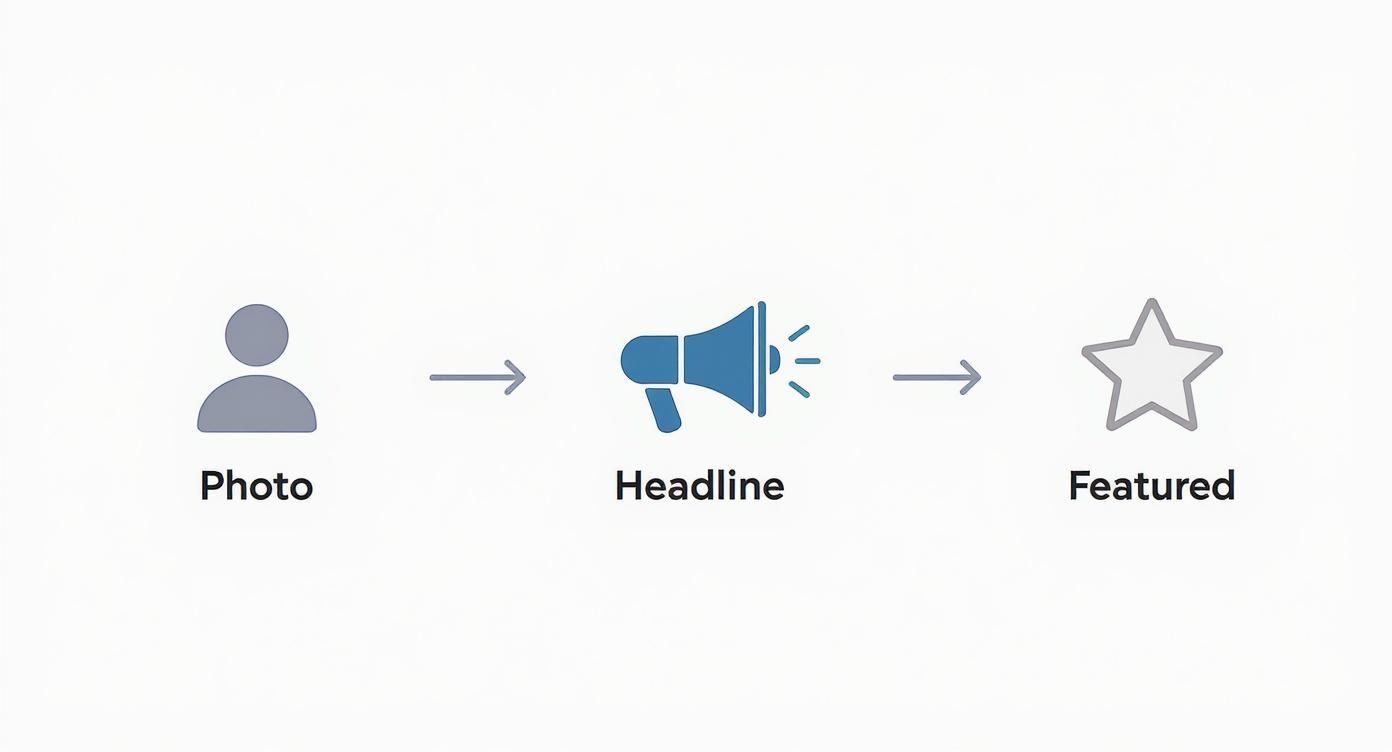
It all starts with a professional photo, is backed by a client-focused headline, and is proven by a strategic Featured section.
Craft a Headline That Sells a Solution
Your headline is the most valuable real estate on your entire profile. It shows up everywhere—next to your name in search results, in connection requests, and on every comment you make. Most people just put their job title, like "CEO at Company X," which is a huge missed opportunity.
Instead, your headline should speak directly to your target audience. A truly effective headline does three things well:
- Identifies who you help: Be specific. "SaaS founders" is better than "business owners."
- States the problem you solve: What keeps them up at night?
- Hints at the result: What's the transformation you provide?
For example, don't just say "Financial Advisor." A much stronger approach is, "I Help Tech Founders Navigate Exit Planning to Maximize Their Net Worth." See the difference? It immediately qualifies and attracts the right kind of person.
Write an 'About' Section That Tells a Story
Your 'About' section is where you get to expand on the promise you made in your headline and build a real human connection. This isn't the place to just list your accomplishments. Treat it like a mini sales page.
Your 'About' section should follow a simple narrative: hook the reader by describing their problem, introduce your solution as the path forward, and end with a clear call to action.
Start by empathizing with your ideal client's struggles. Show them you genuinely get it. Then, briefly explain how your services or experience can help them get past those challenges. Finally, tell them exactly what to do next. That might be inviting them to connect, pointing them to your website, or directing them to a free resource in your Featured section.
Use the Featured Section as a Portfolio
Sitting right at the top of your profile, the Featured section is a visual, high-impact area that many people leave empty. Big mistake. This is the perfect spot to showcase your expertise and give visitors immediate value.
You can use this section to highlight things like:
- Case Studies: Link to a blog post or PDF detailing a client's success.
- Lead Magnets: Offer a free checklist, guide, or webinar to capture email addresses.
- Testimonials: Share a simple graphic with a powerful quote from a happy client.
- Your Best Content: Pin a link to your most popular LinkedIn article or an insightful post.
By curating this space, you transform passive profile viewers into engaged prospects. You're giving them a reason to stick around and a clear path to take the next step.
To make this easier, I've put together a quick checklist you can use to audit your own profile.
Your LinkedIn Profile Optimization Checklist
Use this table as a quick reference to make sure you've covered all the essential bases for turning your profile into a lead-attracting asset.
| Profile Element | Optimization Goal | Key Action |
|---|---|---|
| Profile Photo | Appear professional and approachable | Use a high-quality headshot where you look directly at the camera. |
| Banner Image | Reinforce your value proposition | Create a custom banner with your company logo, a tagline, or a call-to-action. |
| Headline | Attract your ideal client | Focus on the outcome you deliver for a specific audience, not just your job title. |
| 'About' Section | Build trust and guide the next step | Tell a story that addresses client pain points and ends with a clear call-to-action (CTA). |
| Featured Section | Provide immediate value & proof | Showcase your best case studies, lead magnets, or client testimonials. |
| Experience | Demonstrate relevant expertise | For each role, write 2-3 bullet points focused on achievements, not just responsibilities. |
| Skills & Endorsements | Add social proof and keywords | Pin your top 3 most relevant skills and get endorsements from colleagues and clients. |
Going through this checklist is the fastest way to spot and fix the gaps in your profile, ensuring it's fully equipped to convert visitors into leads.
Find and Connect With High-Value Prospects
Alright, your LinkedIn profile is now a lead-generating machine. It’s polished and ready to make a killer first impression. So, what’s next? It's time to shift gears from passively attracting people to proactively finding the right people to talk to.
After all, having the best service in the world doesn't mean a thing if you're pitching it to an empty room. This is where we get strategic. The goal isn’t just to rack up connections; it's to build a valuable network of potential clients.
Master LinkedIn's Search Capabilities
Don't underestimate the power of LinkedIn's native search bar. It’s much more than a tool for finding old colleagues. If you know where to click, you can build incredibly precise prospect lists without spending a dime.
The key is to move beyond a simple name search and hit the "All filters" button. This is where the magic happens. I recommend focusing on these core filters to start pinpointing your ideal customer:
- Job Title: Get specific. Instead of "marketing," try searching for "Director of Marketing" or "Chief Financial Officer."
- Industry: This lets you narrow your focus to the exact sectors you serve best, like "Software Development" or "Financial Services."
- Company Size: Are you targeting scrappy startups or enterprise giants? This filter ensures you’re talking to businesses that are the right fit.
- Location: Essential if your business is local or you're targeting specific geographic markets.
Once you’re ready to get serious and invest in your outreach, LinkedIn Sales Navigator is the undisputed heavyweight champion. It unlocks a whole new level of filtering, letting you find prospects based on things like "Years in current role" or "Posted on LinkedIn in the last 30 days." This allows for some seriously hyper-targeted campaigns.
Craft Connection Requests That Actually Work
You’ve found the perfect prospect. Now, please, don’t blow it by sending the default, generic connection request. We’ve all received them, and they immediately scream "I'm about to pitch you." The acceptance rate is dismal.
A personalized request, on the other hand, shows you've put in a tiny bit of effort and can skyrocket your chances of not just getting a new connection, but starting a real conversation. The golden rule? Make it about them, not you. It only takes 30 seconds of research.
The most effective connection requests reference a specific, relevant detail about the other person. This could be a shared interest, a recent post they made, a mutual connection, or recent news about their company.
Let’s be real. "I'd like to add you to my professional network on LinkedIn" is just lazy.
Compare that to a thoughtful, personalized approach.
Real-World Examples of Personalized Invitations
Let's say you're trying to connect with a marketing director at a fast-growing tech startup. Here are a few ways to cut through the noise:
- Referencing Their Content: "Hi Sarah, I really enjoyed your recent post on the challenges of scaling content teams. Your point about balancing quality and quantity resonated with me. I'd love to connect and follow your insights."
- Mentioning a Mutual Connection: "Hello David, I see we're both connected with Jane Smith from our time at Acme Corp. She always spoke highly of your work. I'm also in the B2B tech space and would be great to connect."
- Citing Company News: "Hi Michael, congrats to you and the team at Innovate Inc. on your recent funding round! It's exciting to see your growth in the fintech space. I follow the industry closely and would be great to connect."
See the difference? Each one is specific, complimentary, and gives a genuine reason to connect that has nothing to do with a sales pitch. This simple shift builds a foundation of mutual interest and respect. Remember, getting your connection request accepted isn't the finish line—it's just the start of the conversation.
Create Content That Pulls Leads To You
Think of your optimized profile as the destination. Your content? That's the engine driving all the traffic there. If you're only doing outbound outreach, you're missing half the picture. The real goal is to create a magnetic effect—to have your ideal clients start coming to you, already warmed up and convinced you know your stuff.
This isn't about throwing random posts at the wall and hoping something sticks. It’s about building a sustainable system that establishes your authority and acts as your best salesperson, working 24/7 to bring in new leads.

Adopt a Problem-Solving Mindset
Here's the single biggest mistake I see people make: they create content that’s all about them. Their company, their product, their latest award. Your audience doesn't care. What they do care about are their own problems and how to solve them.
Before you write a single word, ask yourself this question: "What problem does this solve for my ideal client?" Always frame your expertise through the lens of their needs.
For instance, instead of posting "Our New AI Analytics Feature," try something like "Stop Guessing: 3 Ways to Use Data to Pinpoint Your Most Profitable Customers." The first is a product announcement that gets ignored; the second is a solution that gets clicked. This shift in perspective is everything when it comes to creating content that actually generates leads.
Master the High-Converting Content Formats
Not all content is created equal on LinkedIn. While it's good to mix things up, a few formats consistently punch above their weight for building authority and attracting professional leads. I recommend focusing your energy here for the best return on your time.
- Insightful Text-Only Posts: Short, punchy posts that share a strong opinion, a lesson you learned the hard way, or a counter-intuitive take can do incredibly well. Keep sentences short and use plenty of white space to make them easy to read on a phone.
- Educational Carousels (PDFs): These are absolute gold. You can break down a complex topic into 5-10 easy-to-digest slides. People love them because they deliver a ton of value quickly, which encourages saves and shares. Think of them as mini-presentations.
- Simple Polls with Context: A poll is a great way to kickstart engagement, but the real magic is in the follow-up. Once the poll closes, write a new post analyzing the results and adding your expert commentary. This shows you're not just asking questions, but providing answers.
- Case Studies Disguised as Stories: Don't just list a client's results in a boring list. Tell a story. Talk about their journey from struggle to success and highlight the transformation they experienced. People connect with stories, not data sheets.
These formats work because they feel native to the platform, are easy to consume during a busy workday, and position you as a generous expert.
Remember that generating leads on LinkedIn is a marathon, not a sprint. A prospect often needs to see your content multiple times before they feel comfortable reaching out. Your consistency builds the trust required for that to happen.
Establish a Realistic Posting Cadence
Burnout is the number one killer of a good content strategy. You absolutely do not need to post multiple times a day to get results. Consistency is far more important than frequency.
Pick a schedule you can actually stick with for the long haul. For most of us, posting 2-4 times per week is the sweet spot. It's often enough to stay on your audience's radar without completely taking over your calendar. The key is making sure every single post delivers real value. Quality over quantity, always.
This sustained effort is critical. Industry data shows that a user often sees around 10 pieces of content from someone before making a purchasing decision. That's why showing up consistently is so important—it builds the trust and familiarity you need. You can dig into more of these LinkedIn outreach statistics to see just how the user journey works.
The Anatomy of a High-Impact Post
A great post isn't just about the words; it's about the structure. An effective post that stops the scroll and gets people talking usually has three simple parts.
- The Hook (First 1-2 Lines): This is non-negotiable. Your opening has to grab attention and make someone curious enough to click "...see more." Start with a bold statement, ask a tough question, or hit on a common pain point.
- The Body (The Value): Here’s where you deliver the goods. Use short paragraphs, bullet points, and numbered lists to make the information scannable. Share actionable tips, a personal story, or a breakdown of a complex idea.
- The Call to Action (The Next Step): Don't leave them hanging! End your post by telling the reader what to do next. This doesn't have to be a sales pitch. A great "Call to Discussion" can be as simple as asking a question to get a conversation started in the comments.
Following this simple structure gives your content the best possible chance to connect with your audience and start pulling high-quality leads right to your doorstep.
Turn Engagement Into Meaningful Conversations
Look, creating great content is a huge part of the puzzle, but it's not the end game. If your posts are racking up likes and views but your inbox is empty, you're missing the most important piece. The real magic happens when you turn those passive likes and comments into actual, one-on-one conversations. This is where you shift from being just another content creator to a genuine relationship builder.
The whole point isn't just to be seen—it's to start talking to the right people. Proactive, authentic engagement is the bridge that connects your content to your sales pipeline. It’s all about spotting an opportunity in the comments and sliding into the DMs without being pushy or coming off like a typical salesperson.

Leave Comments That Actually Build Rapport
Your content is great for attracting your ideal prospects, but commenting on their content is where you really build rapport. Don't just scroll past a post from someone on your radar; treat it as an open invitation to connect. I’ve found that one thoughtful comment can do more to build a relationship than ten cold messages ever could.
The key is to ditch the generic, low-effort replies. Comments like "Great post!" or "I agree" are completely forgettable and add zero value. You need to leave comments that are insightful and genuinely add to the conversation.
Here’s a simple framework I use for a high-impact comment:
- Acknowledge and Validate: Start by pinpointing something specific they said and agreeing with it. For example, "You're spot on about the difficulty of scaling content teams."
- Add Your Two Cents: Share a quick personal experience, a unique insight, or ask a follow-up question. Something like, "I found that implementing a tiered review system really helped us maintain quality without slowing everything down."
- Keep it Positive: Your tone should always be helpful and supportive. You're trying to build a bridge, not win a debate.
This approach immediately positions you as a peer and an expert, making that person far more likely to be receptive when you eventually reach out directly.
Transition Gracefully From Public Comments to Private DMs
After a brief, positive exchange in the comments, the natural next step is to move the conversation to a direct message. This is a delicate move, and timing is everything. If you jump into their DMs after a single comment, it can feel aggressive and a little desperate.
You have to wait for the right moment. A perfect trigger is when the conversation in the comments starts getting too detailed or specific for a public forum. That’s your cue to make a natural transition.
Pro Tip: Whatever you do, do not try to sell in your first direct message. The initial DM is purely about continuing the conversation you already started. Your only goal is to build more rapport and learn about their challenges.
For instance, a great transition message might look something like this: "Hey [Name], really enjoyed our chat on your post about content scaling. You mentioned struggling with [specific problem]. I ran into a similar challenge a while back and found a resource that was a game-changer. Happy to share it if you're interested, no strings attached."
See how that’s helpful, not salesy? You're leading with value, which builds trust and opens the door for a deeper discussion down the road.
Master the Art of the Warm DM
This is it. The direct message is where you can truly learn how to generate leads on LinkedIn, but you have to treat it like an art form. Your goal is to be a helpful expert, not a persistent salesperson. The data confirms this—with an average reply rate of 85%, LinkedIn messages blow traditional email out of the water. This incredible engagement rate shows just how powerful personalized, direct communication can be. If you want to dive deeper, you can discover additional insights on LinkedIn outreach statistics to see what makes this channel so effective.
To make sure your outreach always feels warm and authentic, just follow these simple rules:
- Always Have a 'Why': Your message needs a clear, genuine reason for existing that isn't just "to sell you something." This 'why' could be their recent comment, a post they shared, a mutual connection, or even some news about their company.
- Make it About Them: Your message should be 90% about them and only 10% about you. Ask thoughtful questions about their role, what their company is working towards, or a challenge they mentioned publicly.
- End with a Low-Friction Question: Make it incredibly easy for them to reply. Instead of asking for a 30-minute call right away, end with a simple, open-ended question like, "How has that new industry trend been impacting your team?" or "Is that a priority for you guys this quarter?"
By taking this human-first approach, you'll turn engagement from a simple vanity metric into a reliable system for starting real business conversations. You're no longer just collecting connections; you're building a pipeline of warm, qualified leads who already see you as a trusted advisor.
Scale Your Lead Generation with Smart Tools
https://www.youtube.com/embed/-LtGmHnpioI
If you want a predictable stream of leads, you can't do everything by hand forever. The real magic happens when you blend your personal touch with smart technology. This isn't about letting bots take over; it's about using the right tools to amplify your efforts and get your time back.
Think of it this way: good technology handles the repetitive, time-sucking tasks—like tracking outreach and sending initial messages—so you can focus on what actually moves the needle: building relationships and closing deals. It turns random acts of outreach into a consistent, measurable system.
Choosing Tools That Enhance, Not Replace
The market is flooded with LinkedIn "automation" tools, but be careful. Many of them are risky, spammy, and a great way to get your account flagged. Your goal is to find a tool that works like a smart assistant, not a clumsy robot. It should handle the grunt work but leave you in complete control of the personalization and tone.
When you're vetting tools, look for a few key things:
- Human-like engagement: The tool's activity should mimic how a real person uses LinkedIn. This is non-negotiable for account safety.
- Deep personalization: You need to go way beyond just plugging in
[First Name]. Look for the ability to use custom variables that make your messages feel one-to-one. - Robust analytics: If you can't measure it, you can't improve it. You need clear data on what’s working.
- Campaign management: The ability to run multiple, targeted outreach sequences at the same time is crucial for scaling.
A great example of this is a tool like EngageKit. It automates thoughtful, relevant comments to warm up your network before you ever send a DM. This saves you hundreds of hours while keeping every interaction completely authentic. It's the perfect way to use technology to be more present, not less.
Key Metrics You Actually Need to Track
Once you start using tools to scale your outreach, you'll suddenly be swimming in data. It's incredibly easy to get distracted by vanity metrics like impressions or follower count. Forget them.
The only numbers that truly matter are the ones that measure engagement and conversation. These tell you if your strategy is actually generating new business opportunities.
Here are the four essential KPIs to keep your eyes on:
- Connection Acceptance Rate: This is your first major hurdle. A high acceptance rate—ideally 30% or more—proves your profile is compelling and your connection requests are hitting the mark. If this number is low, it’s time to revisit your targeting and your message.
- Reply Rate: This might be the single most important metric. Of the people who connect, how many actually reply to your first message? A low reply rate is a massive red flag that your messaging is falling flat.
- Positive Reply Rate: Let's dig a bit deeper. How many of those replies are genuinely positive or inquisitive, not just "no thanks"? Tracking this helps you gauge the true quality of the conversations you're starting.
- Meetings Booked: This is the bottom line. How many of these conversations are turning into actual sales calls or demos? This KPI tells you if you're not only talking to the right people but also communicating your value effectively.
Analyzing Data to Refine Your Strategy
Tracking these numbers isn't about building a pretty dashboard; it's about taking action. Your data tells a story. It reveals what your ideal prospects care about and how they like to be approached. Use these insights to A/B test every part of your outreach.
Try sending two different connection request messages for a week. Which one got the higher acceptance rate? Great, use that one. Now, test two different opening lines in your first message. Which one boosted your reply rate? That's your new winner.
This continuous loop of testing, analyzing, and refining is how you build a powerful, predictable lead-generation machine.
And the results speak for themselves. Studies have shown that users who see both brand and direct acquisition campaigns on LinkedIn are six times more likely to convert. Marketing teams have reported ROI improvements of 20-30% year-over-year, largely driven by their LinkedIn activities. If you want to dive deeper into the data, you can discover more LinkedIn statistics on Cognism. It’s clear proof that a well-measured and constantly improving strategy pays off big time.
Of course. Here is the rewritten section, focusing on a natural, expert-written tone.
Your Top LinkedIn Lead Generation Questions, Answered
Even with a solid plan in place, you're bound to have questions as you dive into generating leads on LinkedIn. Let's walk through some of the most common ones I hear. Getting these details right can be the difference between spinning your wheels and seeing real results.
I get asked all the time if LinkedIn is still worth the effort, especially with how much it's grown. The answer is an emphatic yes. With around 1 billion professionals on the platform now in 2025, the potential audience is bigger and more active than ever. In fact, the user base has almost doubled since 2022. That isn't just noise; it's a massive pool of fresh opportunity. You can see the data on the platform's incredible growth for yourself.
It’s this sheer scale, combined with its professional focus, that makes your time there so valuable.
How Often Should I Be Posting?
This is the classic quality vs. quantity debate, isn't it? The honest truth is that consistency beats frequency, every single time. You don’t need to be a content machine, posting several times a day to get noticed.
For most people, aiming for 2-4 high-quality posts per week is the sweet spot.
This cadence keeps you on your audience's radar without burning you out. More importantly, it gives you the breathing room to make sure every post you create actually delivers value. One killer post will always outperform five forgettable ones.
What if My Connection Requests Are Getting Ignored?
If you're sending out requests and hearing crickets, it's a clear signal that something in your approach needs fixing. Don't just keep hitting send and hoping for the best—it's time to play detective.
Start by checking a few key things:
- Your Profile: Is it really working for you? A blurry photo, a generic headline, or a sparse "About" section can be immediate turn-offs.
- Your Personalization: Are you still using the default "I'd like to add you..." message? That’s the fastest way to get ignored. Always add a personal note—mention their content, a mutual connection, or something their company recently did.
- Your Targeting: Are you reaching out to people who have a logical reason to connect? If your outreach feels random, it will be treated as such.
Nailing these three simple things can completely transform your acceptance rate.
How Do I Deal with Prospects Who Go Silent?
It happens to everyone. They accept your request, you send a well-crafted message, and... nothing. Don't take it personally, and definitely don't give up after the first try. People get busy, and their inboxes are a warzone.
A gentle, value-first follow-up is completely fine.
A great follow-up never starts with "just following up." Instead, it adds more value. Try sharing a relevant article, offering a quick insight on something they posted, or congratulating them on a recent company win.
This approach re-engages them in a helpful, not a needy, way. If you still don't get a bite after two or three attempts spaced a week or so apart, it's probably time to move on. Focus your energy where it's wanted.