how to grow network on linkedin: The Right Way to Expand Your Connections
Growing your LinkedIn network isn't just about sending out a flurry of connection requests. The real secret? Building a magnetic personal brand before you even click "Connect."

Growing your LinkedIn network isn't just about sending out a flurry of connection requests. The real secret? Building a magnetic personal brand before you even click "Connect." It all starts with turning your profile into a powerful landing page, creating content that naturally draws people to you, and engaging in conversations that matter. Get this foundation right, and you'll find people are actually eager to join your network.
Build a Profile That Invites Connections

Before you can even think about expanding your reach, your own profile needs to be a place people want to land. Stop thinking of it as a dusty old resume and start treating it like a landing page for your professional brand. A half-baked profile doesn't just look lazy; it signals a lack of professional commitment.
Your profile is your digital handshake. It’s the first thing people see, and it can make or break whether they accept your request, reply to your message, or consider you for an opportunity. Every single piece of it, from your photo down to your endorsements, needs to be geared toward building trust and showing your value at a glance.
Craft a Value-Driven Headline
Your headline is prime real estate—it’s arguably the most important text on your entire profile. It follows you everywhere: in connection requests, comment sections, and search results. So, ditch the generic job title and craft a headline that immediately answers every visitor's silent question: "What's in it for me?"
For instance, a simple "Marketing Manager" title could be transformed into something much more compelling:
- Marketing Manager | Driving B2B SaaS Growth Through Content & SEO
- Helping Tech Startups Acquire Customers with Data-Driven Marketing Strategies
These headlines instantly communicate who you are and what problems you solve, making you a far more interesting person to connect with.
Tell Your Professional Story
Your "About" section is where you get to bring your headline to life. This isn't the place for a dry list of skills; it's your space to tell a story. The key is to make it scannable and impactful.
Key Takeaway: A great "About" section should hook the reader, explain who you help and how you do it, and wrap up with a clear call to action—like inviting them to connect or check out your portfolio.
Use short paragraphs and bullet points to make it easy on the eyes. Talk about your professional mission, show off key achievements with real results, and don't be afraid to let a bit of your personality shine through. This turns a boring summary into a story that actually makes people want to connect.
The opportunity here is massive. LinkedIn's user base shot up from 644 million in 2019 and is on track to hit 1.15 billion by 2025—that's nearly double in just six years. With professionals from over 200 countries on the platform, having a sharp, optimized profile is non-negotiable if you want to stand out. You can dive deeper into these trends in Cognism's latest report on LinkedIn statistics.
To make sure you've got all your bases covered, here’s a quick checklist to run through.
Profile Optimization Checklist
This quick checklist will help you ensure every part of your profile is working to attract high-quality connections.
Profile Element | Optimization Goal | Key Action |
|---|---|---|
Profile Photo | Appear professional and approachable | Use a high-quality, clear headshot where you're smiling. |
Banner Image | Reinforce your brand or value proposition | Create a custom banner that includes a tagline, website, or key services. |
Headline | Grab attention and communicate value | Go beyond your job title. Focus on who you help and the results you deliver. |
About Section | Tell a compelling story | Structure with a hook, problem/solution, and a clear call-to-action (CTA). |
Featured Section | Showcase your best work | Pin your top posts, articles, case studies, or links to your portfolio. |
Experience | Detail achievements, not just duties | Use bullet points with quantifiable results (e.g., "Increased leads by 45%"). |
Skills | Validate your expertise | Add at least 5 core skills and get endorsements from colleagues. |
URL | Create a professional, clean link | Customize your public profile URL to be |
Once you've run through this list and polished up your profile, you'll have a strong foundation that makes every other networking activity far more effective.
Turn Your Profile Into a Magnet with Great Content

A great profile gets your connection requests accepted. A smart content strategy gets people to send requests to you. It's a fundamental shift from hunting down contacts to attracting them organically.
When you consistently share valuable stuff, you stop being just another resume and start becoming a go-to resource. Every post builds a little more trust, making you the person people want in their network. Forget the random company updates; the real goal is to become a trusted voice in your corner of the world. This happens when you stop broadcasting and start teaching, sharing your experiences, and telling real stories.
What Should You Talk About? Find Your Content Pillars
Before you even think about writing, you need to decide on your core themes. These are your 2-4 content pillars—the topics you’ll return to again and again. Without them, your feed will feel random and you won't build any authority.
The sweet spot is where your expertise meets your audience's biggest problems. Imagine you're a software developer trying to catch the eye of top recruiters. Your pillars might look like this:
- Pillar 1: Technical Breakdowns. This is where you'd share lessons from a tough coding project or break down a complex concept in simple terms.
- Pillar 2: Career Growth. You could document your journey learning a new language or offer practical advice for junior devs navigating the industry.
- Pillar 3: Industry Commentary. Here, you'd offer your take on the latest tech trends or a new software release, showing you're plugged in.
This framework gives your content focus. People quickly learn what to expect from you, which is how you build a loyal audience that actually cares about what you have to say.
Don't Be a One-Trick Pony: Mix Up Your Formats
Relying on the same type of post every single time is a recipe for boredom. To keep people genuinely engaged, you need to vary your content formats. A healthy mix keeps your feed interesting and appeals to the different ways people like to consume information.
I’ve found the 65/25/10 rule works wonders. Aim for 65% of your content to be purely educational (teaching something valuable), 25% to be personal (sharing stories, behind-the-scenes stuff), and just 10% to be promotional (gently pointing people to what you do).
This balance ensures you're giving way more than you're asking for, which is the key to building real influence.
Find a Posting Rhythm You Can Actually Stick With
Consistency is everything on LinkedIn. The algorithm rewards it, and your audience comes to expect it. Posting five times in one week and then going silent for a month will kill any momentum you build.
For most people, posting 2-3 times per week is the perfect sweet spot. It’s frequent enough to stay on people's radar but not so demanding that you'll burn out. And remember, quality beats quantity every single time. Two thoughtful posts are infinitely better than five lazy ones.
This is the cadence that builds visibility over the long haul. And on the days you can't post, you can still maintain activity. This is where tools like an engagement service can come in handy—keeping your name out there by leaving thoughtful comments on your behalf. That simple, consistent activity, a mix of your own content and genuine engagement, is what turns your profile into a powerful engine for network growth.
Get Out There and Engage With People

Putting out your own content is one thing, but your network really starts to grow when you step into the wider conversation. You can’t just post into the void and hope for the best. The real magic happens with proactive, thoughtful engagement—that's what turns eyeballs into actual connections.
Think of it this way: every meaningful comment you leave is like a mini-billboard for your expertise, placed right where your target audience is already looking. It’s the fastest way to get on the radar of industry leaders and their followers. You're showing that you're not just broadcasting, you're actively listening and contributing. That’s what makes people want to connect.
Ditch the “Great Post!” Comments
Let's be real. "Great post!" or "Thanks for sharing!" is the online equivalent of a limp handshake. It's forgettable, adds zero value, and does absolutely nothing to help you build your network. Your goal is to make the original poster—and everyone reading their comments—stop and think.
A truly great comment is valuable all on its own. It should do one of three things:
- Ask an insightful question that pushes the conversation forward.
- Share a personal story or unique perspective that builds on the original point.
- Pull out a key takeaway and explain why it resonates with you.
This simple shift turns a passive "like" into an active contribution.
Be Strategic, Not Scattered
You can't be everywhere at once. Trying to comment on every post in your feed is a quick recipe for burnout. The smart approach is to focus your energy where it counts.
Start by identifying 5-10 key voices in your industry. These are the leaders, creators, and peers whose audiences you want to get in front of. Make a habit of interacting with their posts.
Beyond that, follow a handful of relevant hashtags to tap into fresh conversations. A dedicated 15 minutes a day of this targeted engagement is all it takes to make a real impact. It’s not about quantity; it’s about the quality and consistency of your interactions.
Expert Insight: As Jasmin Alić, a copywriter who works with top LinkedIn creators, says: “Commenting on LinkedIn is the most hated and the most underrated strategy of all time. But it’s also the best. Treat your comments as mini-posts. You want to educate in 90% of them.”
When you lead with value, relationships start to form naturally. People begin to recognize your name and associate it with smart, helpful insights. Tools like an AI engagement intern can help you maintain this presence consistently, making sure you’re always showing up in the right places, even when you're swamped. This is how you convert passive observers into genuine, high-quality connections.
Perfecting Your Personalized Outreach
Sending a blank connection request is one of the biggest missed opportunities on LinkedIn. Think about it: it's like walking up to someone at a conference, handing them your business card without a single word, and just walking away. It’s cold, transactional, and honestly, pretty forgettable.
The alternative? A little bit of personalization. This isn't about some secret growth hack; it's simply about being human. A short, thoughtful note shows you've actually looked at their profile and have a genuine reason for wanting to connect beyond just boosting your numbers.
The Winning Formula for a Connection Request
A great connection request doesn't need to be a novel. In fact, with a tight 300-character limit, keeping it brief is your best bet. The most effective requests I've seen all follow a simple, three-part flow that you can easily adapt.
It really just boils down to this:
- The Hook: Start by mentioning how you found them or what prompted you to reach out.
- The Common Ground: Pinpoint a specific shared interest, a mutual connection, or something about their work you genuinely admire.
- The Ask: Simply and politely state why you'd like to connect.
This approach transforms a cold request into a warm introduction. It immediately shows respect for their time and establishes a clear point of connection, which can make a huge difference in your acceptance rate.
Crafting Messages That Actually Work
Let's move from theory to practice. Here’s a look at how you can apply this simple formula in a few common professional scenarios to write messages that people actually respond to.
Scenario | Message Template | Why It Works |
|---|---|---|
After a Virtual Event | Hi [Name], I really enjoyed your talk on scaling SaaS operations at the [Event Name] webinar today. Your point about customer feedback loops was especially insightful. I'd love to connect and follow your work. | It's timely, specific, and references a shared experience. It shows you were paying attention. |
Admiring Their Company | Hi [Name], I’ve been following [Their Company]’s journey and was impressed by the recent [Project/Product Launch]. As someone also in [Your Industry], I'd love to connect and learn from your experience. | Flattery with substance. You're showing you know their work and respect their accomplishments, which is a great way to start a professional relationship. |
Shared Interest | Hi [Name], I saw your recent post about [Topic] and thought your perspective was spot on. I’m also passionate about this area and would enjoy connecting with like-minded professionals. | This message creates an immediate sense of community and shared passion, making the connection feel natural and relevant. |
The common thread here is authenticity. Each message is specific—it mentions a real event, project, or post. That little bit of effort is what separates a request that gets accepted from one that gets ignored.
Don't Stop at the Request: The Follow-Up is Key
Getting your connection request accepted is just the start. The real goal is to open a line of communication. A quick follow-up message within a day or two helps solidify that new connection and paves the way for a real conversation down the road.
It can be as simple as this:
"Thanks for connecting, [Name]! I'm looking forward to following your work. If you're ever curious about [Your Area of Expertise], feel free to reach out."
This small gesture is surprisingly powerful. According to LinkedIn's own data, the platform's messages see an average reply rate of 85%—that's three times higher than typical email outreach. It’s a testament to how effective personalized, timely communication can be. You can dig deeper into the effectiveness of LinkedIn outreach in this detailed breakdown.
This simple two-step process—a personalized request followed by a brief welcome message—is all it takes to start building a strong professional relationship from the very first interaction.
Build a Sustainable LinkedIn Growth Habit
Let's be honest: real growth on LinkedIn isn't about one viral post or a week of frantic networking. That's a recipe for burnout. The real secret is consistency. It's about turning those big, overwhelming goals into small, repeatable actions that you can actually stick with.
Think of it less like a sprint and more like building a muscle. You don't go to the gym once and expect results. You show up, do the reps, and over time, the progress becomes undeniable. A structured routine takes the guesswork out of "networking" and turns it into a series of manageable tasks that build powerful momentum.
The 15-Minute Daily Growth Plan
You can move the needle in just 15 minutes a day. Seriously. That's all it takes if you're focused. Tack it onto your morning coffee or slot it in before you head out for the day.
Here’s what that quick, high-impact session looks like:
- Handle Your Inbox First (5 mins): Before you start scrolling, clear your notifications. Reply to messages and any new comments on your content. This keeps the conversations flowing and shows people you're present and engaged.
- Engage with Purpose (7 mins): Don't just mindlessly scroll the feed. Pick 3-5 key people—prospects, partners, industry leaders—and go directly to their profiles. Find their latest post and leave a thoughtful comment that adds to the conversation. This is how you get noticed by the people who matter.
- Connect Intentionally (3 mins): Now that you've engaged, find 1-2 new people to connect with. Maybe it's someone who also commented on that post you just engaged with. Your connection request will be much warmer if you can reference that shared context.
This isn't just a random to-do list; it's a strategic workflow. You're building familiarity before you ever ask for a connection.
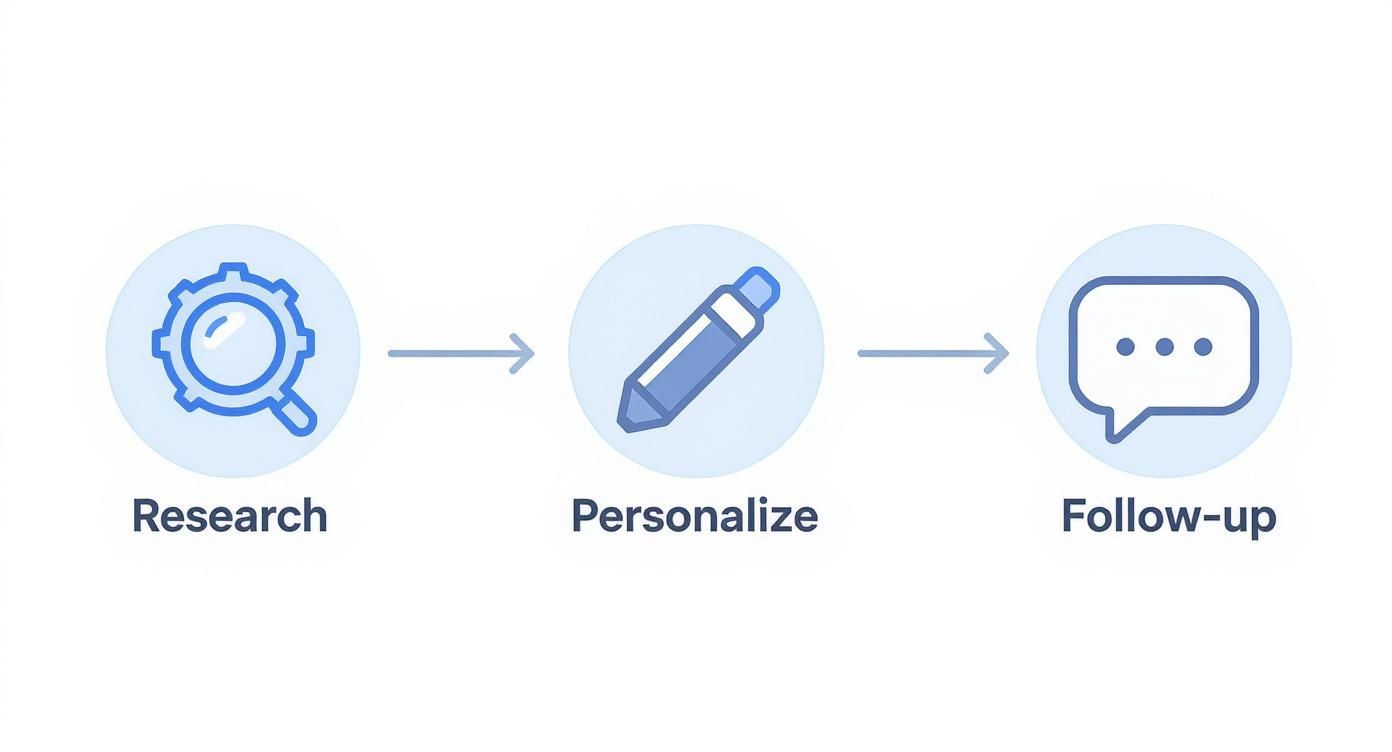
It all starts with a little homework and a personal touch, which naturally opens the door for a real conversation.
Your Weekly Strategy Check-In
While daily actions build momentum, you still need to make sure you're running in the right direction. That's where a weekly check-in comes in. Block off 30 minutes—Friday afternoons work great for this—to zoom out and look at the bigger picture.
Your weekly check-in is where you shift from being a player on the field to being the coach. It’s your chance to review the game tape, see what’s working, and adjust your strategy for the week ahead.
So, what should you be focusing on during this time?
- Plan Your Content: Don't try to come up with post ideas on the fly every day. Use this time to outline your posts for the next week, tying them back to your content pillars. Batching this work is a huge time and sanity saver.
- Review Connection Quality: Take a quick look at the new people in your network. Are they the right people? Are they aligned with your goals? This sanity check helps you refine your targeting for the week ahead.
- Spot New Opportunities: What's happening in your industry? Scan group discussions or trending news to find new topics to talk about or new voices to engage with.
This two-part system—daily tactical execution paired with a weekly strategic review—is the engine for sustainable growth. And if you're stretched for time, you can even bring in help. For instance, tools like EngageKit's engagement intern can handle the daily commenting and interaction, keeping your presence consistent so you can focus on the high-level strategy and conversations. It’s all about turning networking from a chore into a powerful, manageable habit.
Common Questions About Growing Your LinkedIn Network
As you start getting serious about growing your network, a few common questions always seem to come up. It's easy to get tangled in the unwritten rules of LinkedIn, but once you grasp the simple principles of real human connection, you'll know exactly how to move forward.
Let's clear up some of the most frequent sticking points I see people run into.
How Can I Network Without Feeling "Salesy"?
This is a big one. The secret is to completely flip your mindset from "what can I get?" to "what can I give?" Real networking isn't about transactions; it's about building genuine relationships based on generosity.
Instead of jumping straight into a pitch or asking for a favor, focus on establishing a real connection first. It’s simpler than it sounds. Share an article you found interesting, leave a thoughtful comment that adds to their conversation, or connect two people you think should know each other.
When you lead by giving value, any future "ask" feels completely natural. You've already built a foundation of trust and mutual respect.
Is It Quality or Quantity of Connections?
Ah, the classic debate. The truth is, it's not one or the other—it's quality at scale.
Sure, having a huge network gets your content in front of more eyes and bumps you up in search results. But a massive list of people who have no idea who you are or what you do is just a vanity metric. It doesn't actually do anything for you.
Your first job is to connect with high-quality, relevant people in your industry or target market. Get really clear on who those people are. Once you have a solid process for finding and connecting with them, then you can focus on scaling it up. A network of 500+ highly relevant connections will always be more powerful than 5,000 random ones.
Your goal isn't just to be seen, but to be seen by the right people. Nail down relevance first, then expand your reach within that circle.
What Is the Ideal Number of Connections?
There’s no single magic number here, but hitting the 500+ connections mark is a huge milestone. It’s both a psychological and an algorithmic trigger on LinkedIn. The moment your profile switches to showing "500+," you instantly look like an established, active professional to anyone who lands on your page.
Beyond that, the ideal number really depends on what you're trying to achieve.
- Looking for a new job? A few hundred strategic connections at companies you’re targeting might be all you need.
- A founder or in sales? Building a network of several thousand potential clients, partners, and industry peers makes a lot more sense.
- A content creator or thought leader? You'll want to aim for 10,000+ followers to really amplify your message.
Forget about chasing a specific number. Focus on steady, consistent growth. Adding just 5-10 quality connections every single week adds up faster than you think, turning your network into a seriously valuable asset over time.