how to grow network on linkedin: A Practical Guide to LinkedIn Growth

Before you send a single connection request, your LinkedIn profile needs to do the heavy lifting for you. Think of it less like a static resume and more like a dynamic landing page—a resource that pulls your ideal connections in. This is the groundwork, and skipping it is the biggest mistake I see people make. Get this right, and growing a high-quality network becomes infinitely easier.
Build a Profile That Attracts Your Ideal Network
Every single action you take—a comment, a post, an outreach message—sends people back to your profile. It's your first impression, and it’s what convinces someone to hit "Accept." If your profile doesn't immediately signal who you are and the value you bring, all your other networking efforts are dead in the water.
This is more critical now than ever. The platform is massive and only getting bigger. LinkedIn is on track to hit over 1.15 billion users by 2025, which is a mind-boggling 78.6% jump in just six years. With 2-3 new users signing up every second, you have to be sharp to stand out. If you're curious about the numbers, you can discover more LinkedIn growth statistics and see just how fast it's expanding.
Craft a Benefit-Driven Headline and Summary
Your headline is prime real estate. It's not just your job title. It's your value proposition in a single line. Instead of "Marketing Manager at Company X," try something that screams results: "I Help B2B SaaS Companies Scale with Data-Driven Content Marketing." See the difference? One is a label; the other is a solution.
Your "About" section is where you flesh out that promise. This isn't a dry list of responsibilities. It’s your professional story, told with your ideal connection in mind.
- Start with a strong hook. Grab their attention immediately by speaking to a problem they have or a goal they want to achieve.
- Show your work. Don't just list skills. Use short, scannable paragraphs and bullet points to showcase major wins and quantifiable achievements.
- Tell them what to do next. End with a clear call to action. Do you want them to connect? Visit your website? Drop you a message? Be specific.
Leverage Visuals and Social Proof
Let's be honest—people judge a book by its cover. A professional, high-quality headshot is non-negotiable. Profiles with one get 14 times more views. Your banner image is just as crucial. Don't waste it. Use that space to reinforce your brand, spotlight a key service, or communicate your company's mission.
Your LinkedIn profile is the foundation of your networking efforts. Every element, from your headline to your endorsements, should work together to tell a cohesive story about who you are, what you do, and why someone should connect with you.
Visuals go beyond your headshot. Your "Featured" section is your personal portfolio. Pin your best work here—articles, case studies, project links, or presentations that offer tangible proof of your expertise.
Combine this with a well-curated list of skills and genuine endorsements from colleagues, and you've built powerful social proof. This is what turns your profile from a simple resume into a trustworthy professional hub that convinces strangers you're someone worth knowing.
To make this super practical, here’s a quick checklist to run through.
Your LinkedIn Profile Optimization Checklist
Use this table to audit your own profile and identify areas for a quick upgrade. Getting these elements dialed in is the fastest way to make your profile more magnetic.
| Profile Element | Optimization Goal | Quick Tip |
|---|---|---|
| Profile Photo | Look professional, friendly, and approachable. | Use a high-resolution headshot where your face is clearly visible. No party pics! |
| Banner Image | Reinforce your personal brand or company value. | Design a custom banner with a tool like Canva that states your value proposition. |
| Headline | Clearly communicate how you help people. | Go beyond your job title. Focus on the outcome or benefit you provide. |
| About Section | Tell a compelling story of your expertise and value. | Start with a strong hook, use bullet points for achievements, and end with a CTA. |
| Featured Section | Showcase tangible proof of your skills and results. | Pin your top 2-3 pieces of content: articles, case studies, videos, or project links. |
| Experience | Detail achievements, not just responsibilities. | For each role, list 2-3 bullet points with quantifiable results (e.g., "Increased leads by 30%"). |
| Skills & Endorsements | Build social proof and improve search visibility. | Pin your top 3 most relevant skills and proactively ask colleagues for endorsements. |
Once you've checked these boxes, your profile will be working for you 24/7, making every other networking activity far more effective.
Create Content That Pulls Connections to You

While a polished profile gets your connection requests accepted, a smart content strategy makes people send requests to you. This is where sustainable network growth really kicks in. You shift from constantly chasing connections to becoming a magnet for your ideal audience. It’s about moving from a passive scroller to an active creator who shares so much value that people want to be in your orbit.
And believe me, it works. The platform is humming with activity. Engagement among professionals on LinkedIn has never been higher, with a staggering weekly engagement rate of 40%. That shakes out to 372 million active interactions. The platform's average engagement rate sits around 6.50% and is expected to hit 8.01% by early 2025—miles ahead of other social networks. Your content is the key to tapping into this audience. If you need more convincing, just check out these LinkedIn marketing stats to see how active people really are.
Identify Your Core Content Pillars
You don't need to be an expert on everything. The real magic happens when you "own" a few specific topics—your content pillars—that directly line up with your expertise and what your target audience cares about. This focus is what makes you the go-to person in your niche.
So, what unique perspective can you bring to the table? Your pillars could be built around things like:
- Niche Industry Insights: Share data, trends, or observations people can't get just anywhere. For example, a supply chain manager could post a weekly analysis of shipping lane disruptions.
- Personal Career Stories: People connect with other people, not just job titles. Sharing a lesson from a past failure, a big career win, or a behind-the-scenes look at your work builds incredible trust and makes you relatable.
- Educational "How-To" Content: Break down a complex topic into a simple carousel or a short post. A graphic designer could easily create a 5-slide carousel on "Choosing the Right Font for Your Brand."
The goal of your content is not to go viral. It's to build trust with the right people. Consistently showing up with valuable insights for a specific audience is far more powerful than one-off viral hits.
Find Your Posting Cadence and Rhythm
Consistency beats intensity, every time. You don't need to post multiple times a day to grow your network on LinkedIn. Frankly, that’s a fast track to burnout and a feed full of low-quality content.
For most professionals, the sweet spot is 3-4 high-quality posts per week. That’s frequent enough to stay on people’s radar without completely taking over your schedule or flooding their feeds.
Here’s a simple framework to get you started:
- One personal story or reflection: Share a lesson you learned or a personal experience tied to your career.
- One piece of educational content: Teach your audience something genuinely useful. A simple text post with bullet points or a short carousel works great for this.
- One industry insight or opinion: Offer your take on a recent trend, a news story, or a common challenge in your field.
This balanced mix of content helps you build authority, create personal connections, and spark genuine conversations. By sticking to a rhythm like this, you create a predictable flow of value that naturally draws in your ideal connections and turns your profile into a true hub of expertise.
Mastering Proactive Outreach and Engagement
If your content is your storefront, proactive engagement is you stepping outside to greet people on the street. It’s how you take the driver’s seat and actively grow your network. This is where you shift from passively hoping people find you to actively starting conversations and building genuine rapport.
Think of it this way: thoughtful engagement is the single most powerful—and most overlooked—strategy for getting noticed on LinkedIn. It puts you directly in front of your ideal audience and the audiences of major players in your industry, without you having to post a single thing.
The Art of the Value-Add Comment
Let's be clear: a "Great post!" or "Thanks for sharing!" comment is completely invisible. It's digital noise. The goal isn't just to be seen; it's to be seen as someone who brings value to the table. Your comments should be treated like mini-posts, each one an opportunity to share a new perspective or a helpful insight.
A truly powerful comment usually does one of three things:
- Builds on the conversation: You can expand on the author’s point by adding a related statistic, a quick personal story, or another piece of the puzzle.
- Asks a smart question: This shows you’ve actually read the post and are thinking critically about the topic. It’s a great way to spark further discussion.
- Offers a respectful counterpoint: Constructively challenging an idea positions you as a strategic thinker and can kick off a fascinating debate that draws more eyes to your comment (and your profile).
"Commenting on LinkedIn is the most hated and the most underrated strategy of all time. But it’s also the best. Treat your comments as mini-posts. You want to educate in 90% of them.” - Jasmin Alić, Co-founder of Linkbound.io
Make it a habit to drop 5-10 of these high-value comments every day on posts from influential people in your niche. Soon, people will start to recognize your name. They’ll get curious, click on your profile, and start sending you connection requests. It’s the perfect warm-up before you ever send a request yourself.
Crafting Connection Requests That Actually Get Accepted
After you've been showing up in the comments for a while, people will already have a sense of who you are. This makes your connection requests feel much warmer and far more likely to be accepted. Even so, sending a personalized note is non-negotiable. An empty request is just lazy, and LinkedIn gives you 300 characters to explain why you want to connect. Use them.
The secret is context. Your note needs to immediately answer the other person's silent question: "Why should I connect with you?" Keep it brief, specific, and focused on them, not you.
Here are a few scenarios to give you an idea:
- You engaged with their post: "Hi [Name], I really enjoyed your recent post on [Topic]. Your point about [Specific Insight] was spot-on. Would love to connect and follow your work."
- You have a mutual connection: "Hi [Name], I see we're both connected with [Mutual Connection's Name]. I'm also working in the [Industry] space and think it would be great to connect with like-minded pros."
- You're impressed by their work: "Hi [Name], I've been following your work at [Company] for a while and was really impressed by [Specific Achievement]. It would be an honor to connect."
The difference between a generic, thoughtless request and a personalized one is night and day. Take a look at these examples.
Sample LinkedIn Connection Request Templates
| Scenario | Generic (Avoid) | Personalized (Use) |
|---|---|---|
| Shared Group | "I'd like to add you to my professional network on LinkedIn." | "Hi Jane, I saw your thoughtful comment in the 'SaaS Founders' group about churn reduction. Your perspective on user offboarding was insightful. Would love to connect." |
| Event Attendee | "I'd like to connect with you." | "Hi Mark, I really enjoyed your presentation on AI in marketing at the MarTech Summit yesterday. I had a question about your data model but didn't get a chance to ask. Hope we can connect." |
| Thought Leader | "Please add me to your network." | "Hi Sarah, I've been following your newsletter on product-led growth for months. The recent issue on activation metrics completely changed how I approach my work. Would be great to connect here." |
See the difference? Personalization shows you've done your homework and respect the other person’s time. This simple shift turns a cold outreach into a warm introduction, setting the stage for a real professional relationship, not just another number in your connection count.
Create a Sustainable Networking Routine That Actually Works
Consistency is the single biggest factor in growing your LinkedIn network, but let's be realistic—it can't feel like a second full-time job. The secret isn’t more hustle; it’s a smarter system.
The most effective way to build momentum is to break your networking down into small, repeatable habits that fit into your day. Forget about trying to do everything at once. We're talking about a manageable daily and weekly cadence that prevents burnout and produces real, compounding results. You'd be amazed at what just 15-20 minutes a day can do when you focus on the right things.
The 15-Minute Daily Networking Block
Your daily routine is all about staying visible and engaged. Think of these as quick, high-impact tasks that keep the flywheel spinning and build relational capital with your network.
- Handle Your Inbound Engagement: First things first, respond to every comment on your own posts. This is non-negotiable. It tells the algorithm your content is valuable and, more importantly, shows your audience you’re listening.
- Meaningful Feed Engagement: Spend about 10 minutes scrolling your feed, but do it with purpose. Drop thoughtful, value-adding comments on posts from key people you want to build relationships with. Go beyond "great post!" and add a perspective or ask a question.
- Send a Few Targeted Requests: Aim to connect with just 3-5 new people each day. The key is context. Reference a post they wrote, a mutual connection, or a comment they left elsewhere. A little personalization goes a long way.
This simple, daily habit is what separates the people who grow their network from those who just collect connections.
Your Weekly Growth and Review Hour
Once a week, you need to zoom out. Set aside a dedicated hour to work on your networking strategy, not just in it. This is your time for planning, content creation, and nurturing the relationships you've started.
This is the core loop of effective outreach in a nutshell: engage first, personalize your approach, and then send the request.
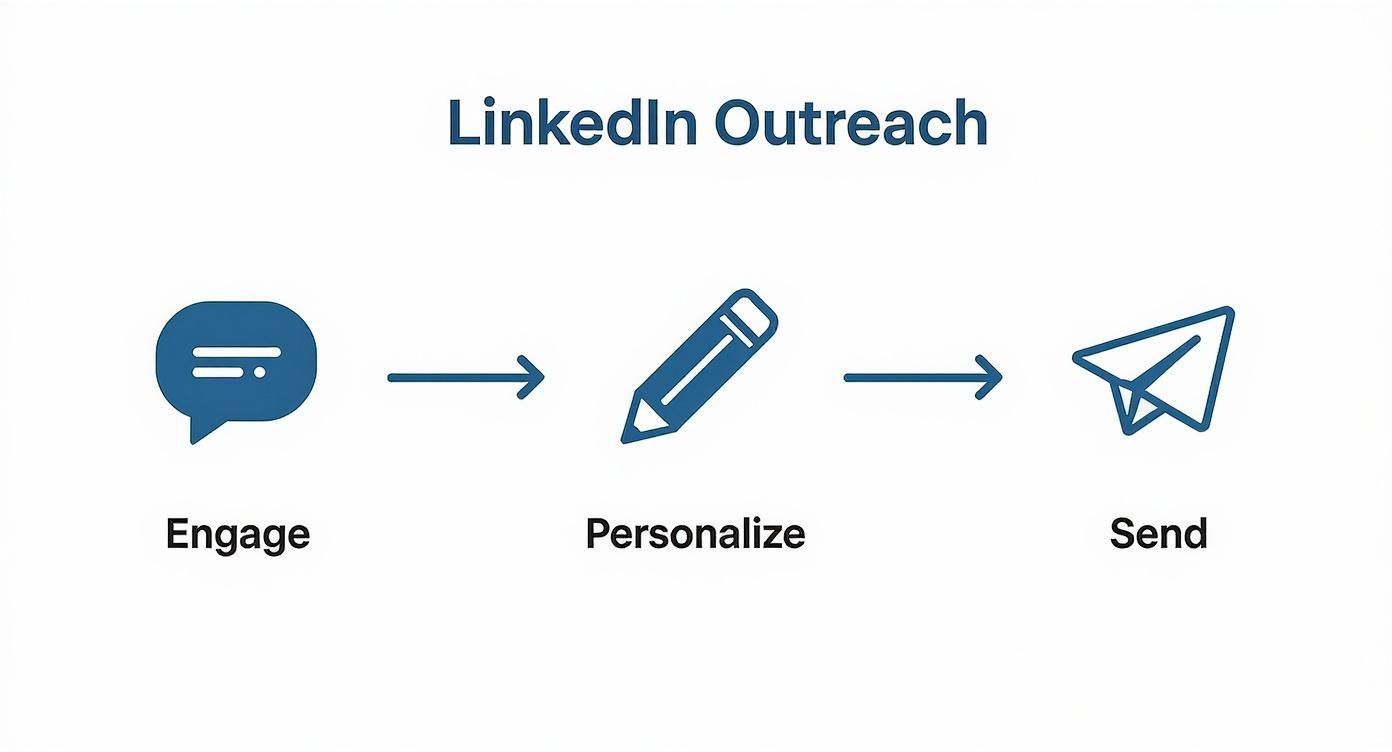
As the visual shows, the work starts long before you ever hit that "Connect" button.
Your weekly tasks are about steering the ship, not just rowing. This is where you ensure your daily efforts are actually moving you toward your goals and that no new connection goes cold.
Here’s what your weekly checklist should cover:
- Batch Your Content: Draft and schedule your posts for the week ahead. Getting this done in one go frees up a ton of mental energy during the week and guarantees you’ll post consistently.
- Nurture New Connections: Go through the new connections you made last week. Don't let them sit idle. Send a brief, friendly follow-up to get a real conversation started. The goal is to move from a connection to a relationship.
- A Quick Analytics Check-In: Pop over to your analytics. Which posts got the most engagement? What topics are hitting home? A quick glance will tell you what's working so you can double down on it next week.
Scale Your Efforts with Smart Tools and Practices

Once you’ve got a solid networking routine down, you'll naturally start thinking about how to get more done without losing the personal touch that made it work. This isn’t about hitting a button and spamming hundreds of generic connection requests—that’s a quick way to burn your reputation.
Instead, we're talking about building smart systems that let you amplify your voice and accomplish more with the time you have. It's about freeing up your brainpower for the meaningful conversations that actually matter.
Build Your Personal Content and Comment Library
After a while, you’ll find yourself saying the same things. You'll comment on similar industry topics and answer the same kinds of questions. Instead of reinventing the wheel every single time, create a personal library of your best stuff.
- Comment Starters: Keep a simple document with a few go-to frameworks for commenting on common themes in your niche. Maybe you have a specific way you like to analyze industry trend posts or share an opinion on leadership challenges.
- Message Templates: Save your most effective outreach messages. Think about that great template you used to follow up with a new connection or the one for reconnecting with someone after a few months.
This isn't about becoming a robot. It’s about being efficient. You still need to tailor every single message and comment to the specific person and situation, but starting with a solid foundation saves a ton of time.
Smart scaling on LinkedIn means automating the repetitive tasks to free up more time for human connection. The tools should support your strategy, not replace your voice.
Delegate the Right Tasks Not the Relationships
Delegating can be a huge help, but you have to be careful. Here’s the golden rule: delegate the research, not the relationship. Your authentic voice is your most important asset, so you should never hand off your personal comments or direct messages.
Where a virtual assistant (VA) or a specialized tool can really shine is in finding the opportunities for you to engage with.
- Task for a VA: "Find 10 posts from VPs of Marketing at SaaS companies talking about Q3 planning. Drop the links in a spreadsheet so I can jump in and comment."
- Task for a Tool: An AI-powered tool like EngageKit can act like an engagement intern. It can surface relevant posts and even draft comments in your unique style. You always have the final say to review, edit, and approve, but it does the time-consuming work of finding the conversations.
This approach lets you spend your limited time on what you do best: crafting that perfect, insightful comment or personal message. You stay the face and voice of your brand, while the systems you've built work behind the scenes to bring the best opportunities right to your doorstep.
Common Questions Answered
When you're serious about growing your LinkedIn network, a few questions always pop up. Let's tackle some of the most common ones I hear from people trying to scale their presence on the platform.
How Many Connection Requests Should I Send Every Week?
Forget the weekly limit LinkedIn imposes. The real game isn't about volume; it's about your acceptance rate. I always tell people to aim for 5-10 highly personalized requests each day.
Think about it: a high acceptance rate from a small batch of thoughtful invites tells LinkedIn you're a valuable networker. A low acceptance rate on a massive, generic blast just makes you look like a spammer. Focus on quality connections, not just a high connection count. Your account's health will thank you for it.
What's the Best Content to Post to Get People Talking?
There's no magic bullet, but a strategic mix works wonders. You want to hit your audience from a few different angles. A good rhythm to get into involves a blend of these formats:
- Plain Text Posts: Don't underestimate the power of a good story or a sharp insight. These are quick to write and often get fantastic engagement because they feel personal and direct.
- Carousels (as PDFs): These are absolute gold for educational content. You can break down a complex idea into bite-sized, easy-to-digest slides. People love to save and share these.
- Polls: Need a quick engagement boost? Polls are your best friend. They're low-effort for your audience and a great way to take the pulse of your network.
- Video: It takes more work, no doubt. But nothing builds that "know, like, and trust" factor faster than showing your face and sharing your voice.
Ultimately, the format is secondary. What really matters is being consistent and genuinely helpful to the people you're trying to reach.
Your goal shouldn't be a single viral post. It's about consistently showing up and providing value that attracts and keeps the right people engaged with your work. That's how you build a real community.
Is LinkedIn Premium Actually Worth the Money for Growth?
This one's a classic "it depends." LinkedIn Premium can be a powerful accelerator, but only if you have a solid strategy to accelerate in the first place.
If you're in sales or recruiting, the advanced search filters and extra InMails can be a game-changer for targeted outreach. Seeing who's viewed your profile is also a nice perk for finding warm leads.
But let's be clear: you can build an incredibly powerful network on a free account. By nailing your profile, creating great content, and engaging thoughtfully, you can achieve massive growth without paying a cent. Don't think of Premium as a shortcut. See it as a tool to put more fuel on an already burning fire.