How LinkedIn DM Automation Impacts Rapport
Automation saves time but erodes LinkedIn rapport when messages feel generic — use personalization and human approval to stay compliant and build trust.

Automation tools for LinkedIn DMs can save time by handling repetitive tasks like sending connection requests and follow-ups. But if used poorly, they can harm professional relationships. Here’s the key takeaway: automation works best when combined with personal touches and human oversight.
-
Risks of Poor Automation:
- Generic messages feel spammy and reduce trust.
- Overuse leads to message fatigue and damages credibility.
- LinkedIn’s strict policies can result in account bans for excessive or rule-breaking automation.
-
When Automation Works:
- It’s effective when messages are personalized, context-aware, and sent at reasonable intervals.
- Engaging with prospects’ content (e.g., liking posts or commenting) before messaging builds familiarity.
-
Best Practices:
- Use a "human-in-the-loop" approach: let automation handle basic tasks, but review and personalize messages yourself.
- Target specific audiences instead of mass messaging.
- Focus on building real connections, not just increasing outreach numbers.
Bottom line: Automation can streamline outreach, but over-reliance on it without personal input risks damaging relationships. Combine automation with human judgment for better results.
Problems with LinkedIn DM Automation for Building Rapport
Generic Messages Reduce Trust
Using generic templates in LinkedIn messages can seriously harm professional relationships. When recipients notice that a message feels mass-produced, they’re likely to dismiss it outright as unimportant or insincere [3]. Even adding basic personalization - like including someone’s name - doesn’t fix the problem. People can easily recognize when a message lacks genuine effort. On a platform where trust is key, relying on overused templates can ruin any chance of forming meaningful connections [3][4].
But it’s not just about trust. Overloading someone’s inbox with automated messages can also damage professional relationships in other ways.
Message Fatigue and Spam Risks
Automated outreach often leads to message fatigue. Professionals on LinkedIn are already overwhelmed with unsolicited pitches, and receiving repetitive, formulaic messages only adds to the frustration [5][6]. These types of messages are easy to spot and are often flagged as spam. Once flagged, they’re not just ignored - they harm your reputation. Repeatedly sending such messages creates a negative experience for recipients, making it even harder to engage with them in the future [5][7][8].
And the risks don’t stop there. Automation can also get you into trouble with LinkedIn itself.
LinkedIn Policy Violations and Account Penalties
LinkedIn has strict rules against using automation tools for messaging. Violating these rules can lead to serious consequences, ranging from temporary suspensions to permanent bans. LinkedIn’s algorithms are designed to detect suspicious patterns, like sending too many connection requests or identical messages in a short period. For example, in March 2025, LinkedIn banned popular platforms like Apollo.io and Seamless.ai for scraping data and breaking its policies, showing just how seriously it takes these violations [3][4].
"Any member who uses tools for such purposes is in violation of the User Agreement. This means that they risk having their accounts restricted or shut down. They also risk the possibility that any prohibited tools they're using may become non-operational without notice."
- LinkedIn [3]
Beyond losing access to your account, these penalties can severely damage your professional credibility. Once that trust is broken, rebuilding relationships on the platform becomes nearly impossible.
LinkedIn Automation Crackdown: How to Stay Compliant and Avoid Account Suspension
When Automation Helps or Hurts Relationships
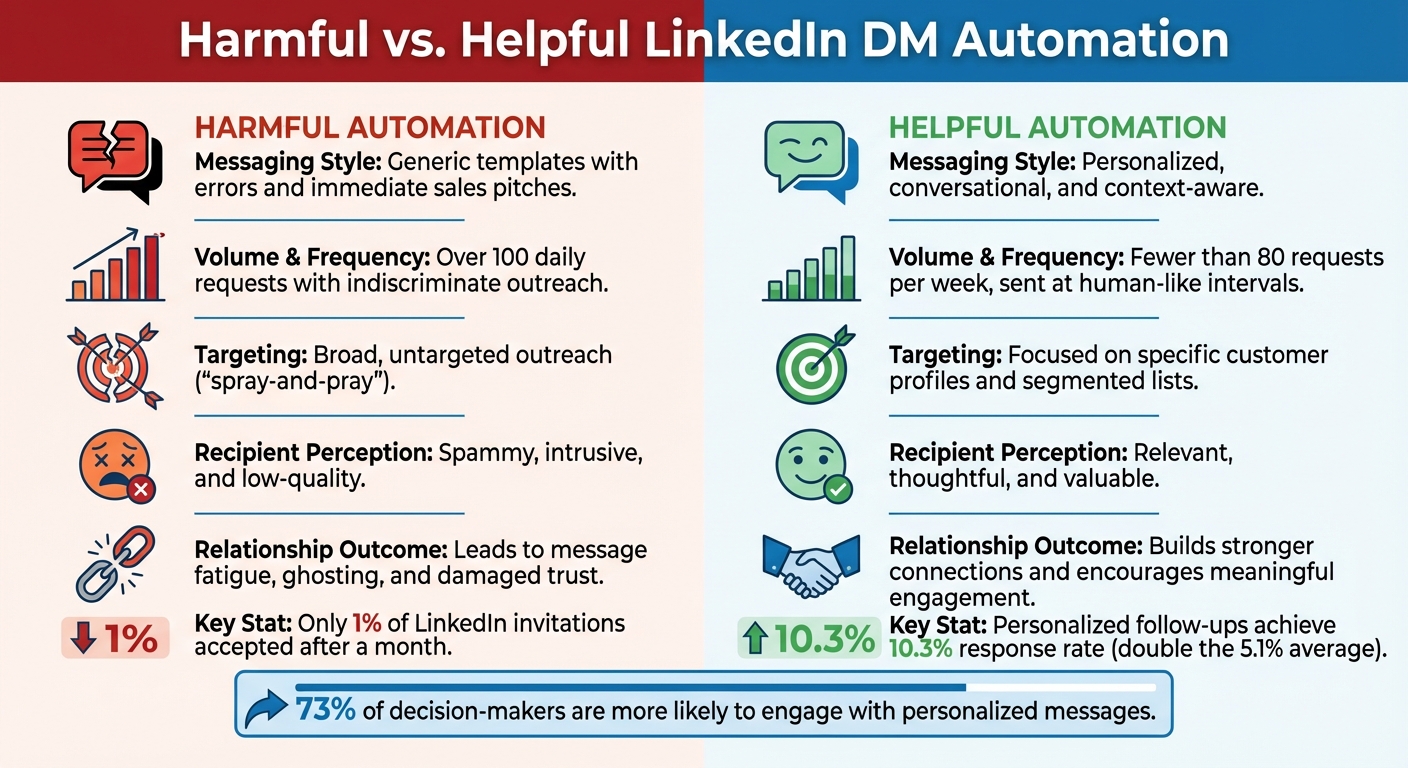
Harmful vs Helpful LinkedIn DM Automation Comparison
Finding the right balance between efficiency and genuine connection is the main challenge when using automation on LinkedIn.
When Automation Works Well
Automation shines when it mimics human behavior and prioritizes meaningful interactions over sheer volume. For example, engaging with a prospect’s content - by viewing their profile, liking posts, or sending a connection request - creates a sense of familiarity. Once connected, following up with tailored messages that provide real value can make a big difference. In fact, personalized follow-ups can double response rates, achieving 10.3% compared to the 5.1% average for cold emails [2]. The key is using automation to build relationships, not just to increase outreach numbers.
However, when used carelessly, automation can have the opposite effect.
When Automation Backfires
Automation can harm relationships when it focuses on speed and quantity rather than quality. Sending over 100 connection requests daily or using generic, mass-produced messages often leads to distrust [9]. People easily recognize copy-paste messages, especially those riddled with errors or aggressive sales pitches. Continuing to contact someone who isn’t engaging comes across as intrusive. The numbers speak for themselves: only 1% of LinkedIn invitations are accepted after a month, making poorly targeted or generic outreach a wasted effort [10]. When automation feels robotic or pushy, it doesn’t just fail - it actively damages relationships.
Comparison Table: Helpful vs. Harmful Automation
| Aspect | Harmful Automation | Helpful Automation |
|---|---|---|
| Messaging Style | Generic templates with errors and immediate sales pitches | Personalized, conversational, and context-aware |
| Volume & Frequency | Over 100 daily requests with indiscriminate outreach | Fewer than 80 requests per week, sent at human-like intervals |
| Targeting | Broad, untargeted outreach ("spray-and-pray") | Focused on specific customer profiles and segmented lists |
| Recipient Perception | Spammy, intrusive, and low-quality | Relevant, thoughtful, and valuable |
| Relationship Outcome | Leads to message fatigue, ghosting, and damaged trust | Builds stronger connections and encourages meaningful engagement |
Human-in-the-Loop Approach: Combining Automation with Personal Review
When it comes to balancing efficiency and authenticity in communication, integrating human oversight into automated processes offers a practical solution.
Instead of relying solely on automation or discarding it altogether, a human-in-the-loop approach merges the strengths of automated workflows with the nuance of human judgment. Automation handles repetitive tasks, while you step in to refine and personalize, ensuring every interaction feels genuine and meaningful.
How Human Review Enhances Automated Messages
AI can draft messages, but it’s the human touch that ensures they resonate. By reviewing these drafts, you can refine the tone, streamline the content, and align it with your brand’s voice. Research supports this: 73% of decision-makers are more likely to engage with messages that feel personal, and personalized outreach can double response rates from 2.8% to 6.5% [11]. While AI can analyze prospect data and suggest content, your insight is vital for catching awkward phrasing and ensuring the message fits the context perfectly.
Steps for Rapport-Safe Automation
To strike the right balance, start with targeted audience segmentation. Use tools like LinkedIn’s search filters or Sales Navigator to narrow your list by industry, job title, or company size. For high-value prospects, dig deeper by manually researching their profiles and recent activity. Look for triggers - like a new job, a promotion, or a shared post - that can inform your outreach.
Once you’ve gathered this information, let AI draft message templates. Keep them concise and avoid hard sales pitches, especially in initial contact. Then, review and refine each message to ensure it sounds natural and personal. To avoid appearing spammy, set daily limits and use platforms that randomize send times. These tools can also pause activity automatically if unusual behavior is detected, helping you stay compliant.
How EngageKit Supports Human-in-the-Loop Messaging
EngageKit is designed to keep you in control of your outreach. Every engagement requires your approval, ensuring nothing gets sent without your consent. The platform also helps you track connections through targeted lists and tailored searches, making it easier to reach out to the right people at the right moment.
Before sending a direct message, EngageKit encourages meaningful interactions with your prospects’ content - whether it’s liking posts or leaving thoughtful comments. This approach builds familiarity, so when you do send a message, it feels like a natural progression rather than an unsolicited pitch. Over time, this method strengthens connections and boosts results, blending efficiency with genuine engagement.
Comparison Table: Fully Automated vs. Human-in-the-Loop Workflows
| Aspect | Fully Automated | Human-in-the-Loop |
|---|---|---|
| Control Level | Software decides what to send and when | User approves every message before sending |
| Personalization Depth | Limited to basic variables like {first_name} | Context-specific messages with researched details |
| Rapport Impact | Often feels robotic and impersonal | Maintains a natural, genuine tone |
| Compliance Risk | Higher risk of spam-like activity | Lower risk with human oversight |
| Response Quality | Generic replies, often ignored | Encourages meaningful, engaged conversations |
Guidelines for Maintaining Rapport with LinkedIn DM Automation
When using LinkedIn DM automation, the key to success lies in maintaining a balance between efficiency and genuine connection. The aim isn’t to flood inboxes with messages but to send thoughtful, well-timed outreach to the right people.
Target Specific Audiences, Not Large Volumes
Focus on reaching prospects who truly align with your product or service. Use LinkedIn's search filters to narrow down individuals by industry, job title, company size, or location. Precision in targeting ensures your outreach feels relevant and valuable. As Paul Petrone, AI GTM Marketing @ LinkedIn, explains:
"The data also highlights the worst way to InMail – the 'quantity over quality' approach, where you are just sending to whoever with generic messaging. Not only is that strategy ineffective, it erodes you and your company's brand over time." [15]
While automation can streamline the process, the strategy behind it determines whether your messages resonate or come across as spam. Building rapport starts long before hitting "send."
Engage Before Sending Direct Messages
Establish familiarity before reaching out. LinkedIn data shows that viewing a prospect’s profile and sending an InMail within 30 days increases the likelihood of acceptance by 78%. Similarly, following a prospect’s company boosts acceptance rates by 15%. [15]
Start small - like their posts, leave thoughtful comments, or simply view their profile. These actions create a sense of recognition, so when your message arrives, it feels less intrusive and more like a natural continuation of prior engagement.
Personalize Messages Based on Context
Generic messages tend to be ignored. Tailoring your outreach based on specific details makes your message stand out. Personalized messages can increase acceptance rates by 40%, and 71% of consumers expect businesses to deliver tailored experiences. [14]
Reference something unique from a prospect’s LinkedIn profile, recent activity, or shared industry challenges. For instance, Expandi shared in January 2025 how users could automate personalized DMs to people who commented on posts. A message like:
"I really enjoyed your insights on [Topic]. Would love to hear more about how you're addressing this challenge!" [13]
can spark meaningful conversations. Avoid shallow personalization, like just using a recipient’s first name. Instead, take the time to show genuine interest. As David C. Baker advises:
"The only way to consistently cut through the noise of hyper targeting and AI shitification is to speak human to human, and you're probably pretty good at it, so give it a try." [12]
Thoughtful personalization not only grabs attention but also lays the groundwork for stronger connections.
Track Relationship Quality, Not Just Response Rates
Focus on engagement that builds relationships. A simple "not interested" counts as a reply, but it doesn’t foster rapport. Instead, track metrics that reflect deeper engagement - like connection acceptance rates, scheduled meetings, or positive sentiment in responses.
Leverage sentiment analysis to prioritize follow-ups and refine your approach. [2] Look beyond initial replies and assess how conversations evolve. Are they leading to calls, multi-message exchanges, or other meaningful interactions? This is where real relationship-building happens.
Pros and Cons of DM Automation for Rapport
| Aspect | Pros | Cons |
|---|---|---|
| Efficiency | Saves time on repetitive tasks, enabling focus on high-value conversations | Can feel impersonal if not carefully managed |
| Personalization | Allows for targeted outreach with context-specific details | Overuse of templates risks eroding trust and damaging brand reputation |
| Relationship Building | Warm-up activities (likes, comments) help establish familiarity | Over-automation without human oversight can lead to spam-like experiences |
| Compliance | Proper limits and human review reduce policy violation risks | Fully automated workflows increase the likelihood of account penalties |
| Response Quality | Thoughtful, personalized messages encourage meaningful conversations | High-volume, low-quality outreach often results in ignored messages |
Conclusion: Balancing Automation and Personal Connection
LinkedIn DM automation can be a game-changer for scaling outreach while freeing up time for meaningful conversations. But here's the catch: the success of automation hinges entirely on how strategic and personalized your messaging is. The sender holds the power to make messages feel either engaging or spammy, depending on the quality of the content, timing, and level of personalization [1]. When automation replaces genuine human connection, it erodes trust, alienates prospects, and could even lead to account penalties.
The goal isn’t to ditch automation altogether - it’s about blending it with human judgment to maintain efficiency without losing authenticity. A "human-in-the-loop" approach strikes this balance by combining the speed of automation with the insight only a person can provide [17][18]. This means taking the time to review messages, tailoring them with real insights, and engaging with prospects' content before initiating contact. Think of connections as relationships to build, not just numbers to hit. This thoughtful mix of automation and personal touch transforms routine outreach into genuine engagement.
Ethical oversight also plays a critical role in maintaining trust. As Virtual Operations highlights:
"AI lacks the ability to understand context and make ethical judgments in the way humans do. In situations that require moral or ethical considerations, human oversight ensures that decisions are made with a sense of responsibility and accountability." [17]
Automation should serve as a tool to strengthen relationships, not replace them [16]. Use it for repetitive tasks, but save the more nuanced and in-depth interactions for yourself. Focus on tracking the quality of relationships through meaningful markers - like scheduled meetings, ongoing conversations, and positive sentiment - not just response rates. Tools like EngageKit take this approach seriously by requiring approval for every interaction, ensuring each message aligns with your brand and values.
The professionals thriving on LinkedIn in 2025 won’t be the ones flooding inboxes with generic messages. Instead, they’ll be the ones sending thoughtful, relevant, and genuinely valuable messages to the right people - those who truly matter to their business. This balance between automation and human connection underscores the key takeaway: efficiency is important, but it should never come at the cost of authenticity.
FAQs
How can I use LinkedIn DM automation to build stronger connections?
To make the most of LinkedIn DM automation while maintaining genuine connections, prioritize personalization. Reference something specific, like a recent achievement, a post they’ve shared, or a mutual interest. This makes your message feel relevant and thoughtful. Keep your tone warm yet professional, and keep it short to respect their time.
Pair automation with real engagement by interacting with their content beforehand. Leave meaningful comments or reactions to show genuine interest. This small effort can help build rapport and improve the chances of receiving a meaningful reply. The secret lies in blending automation with a personal touch to nurture trust and create lasting relationships.
What are the risks of using LinkedIn DM automation without proper human involvement?
Using LinkedIn DM automation without any human involvement can backfire in significant ways. One major risk is facing account restrictions or even permanent bans. This typically happens when automation tools breach LinkedIn’s policies by performing actions like scraping data, sending unsolicited messages, or imitating human behavior.
Beyond policy violations, relying too heavily on automation can damage your professional image. Messages that feel generic or impersonal can come off as spam, making it difficult to foster meaningful connections. To sidestep these issues, it’s essential to keep a personal touch in your interactions and ensure everything you do stays within LinkedIn’s guidelines.
What should I know about LinkedIn's rules on using DM automation tools?
LinkedIn takes a firm stance against automation tools that breach its Terms of Service - this includes tools used for bulk connection requests, automated messaging, or data scraping. Violating these policies can result in serious consequences, such as account restrictions or even permanent suspension.
To avoid these risks, stick to tools that emphasize manual approval and promote genuine engagement. This approach not only keeps you within LinkedIn’s rules but also helps you cultivate meaningful and trustworthy connections over time.