LinkedIn Response Benchmarks for 2025
2025 LinkedIn reply benchmarks: DMs avg 10.3%, Messenger 16.9%, InMails 3–8% (10–15% with personalization). Timing and follow-ups boost replies.

LinkedIn response rates in 2025 reveal how well outreach efforts perform, with reply rates ranging from 10% to 15% on average. Achieving over 20% signals strong performance, while rates above 30% place you in the top tier. InMails have lower averages (3%–8%) but can climb to 10%–15% with personalization. Key insights include:
- Direct Messages (DMs): Average reply rate is 10.3%, outperforming cold emails at 5.1%.
- Messenger Campaigns: Targeting first-degree connections yields a higher 16.86% response rate.
- InMails: Premium campaigns see 18%–25%, but the average is 6.38%.
- Follow-ups Matter: Multi-step sequences (2–3 follow-ups) can boost response rates to 20%–30%+.
- Timing: Best results come from sending messages on Tuesdays or midweek mornings.
Personalization and targeting are critical for improving engagement. Messages tailored to recipients’ achievements or shared connections see 27% higher response rates. Tools like EngageKit can help track and refine outreach strategies to align with these benchmarks.
LinkedIn Response Rate Benchmarks 2025: DMs vs InMails vs Cold Email
This LinkedIn Message Gets 30% Response Rates & Prints Money
2025 LinkedIn Response Rate Data
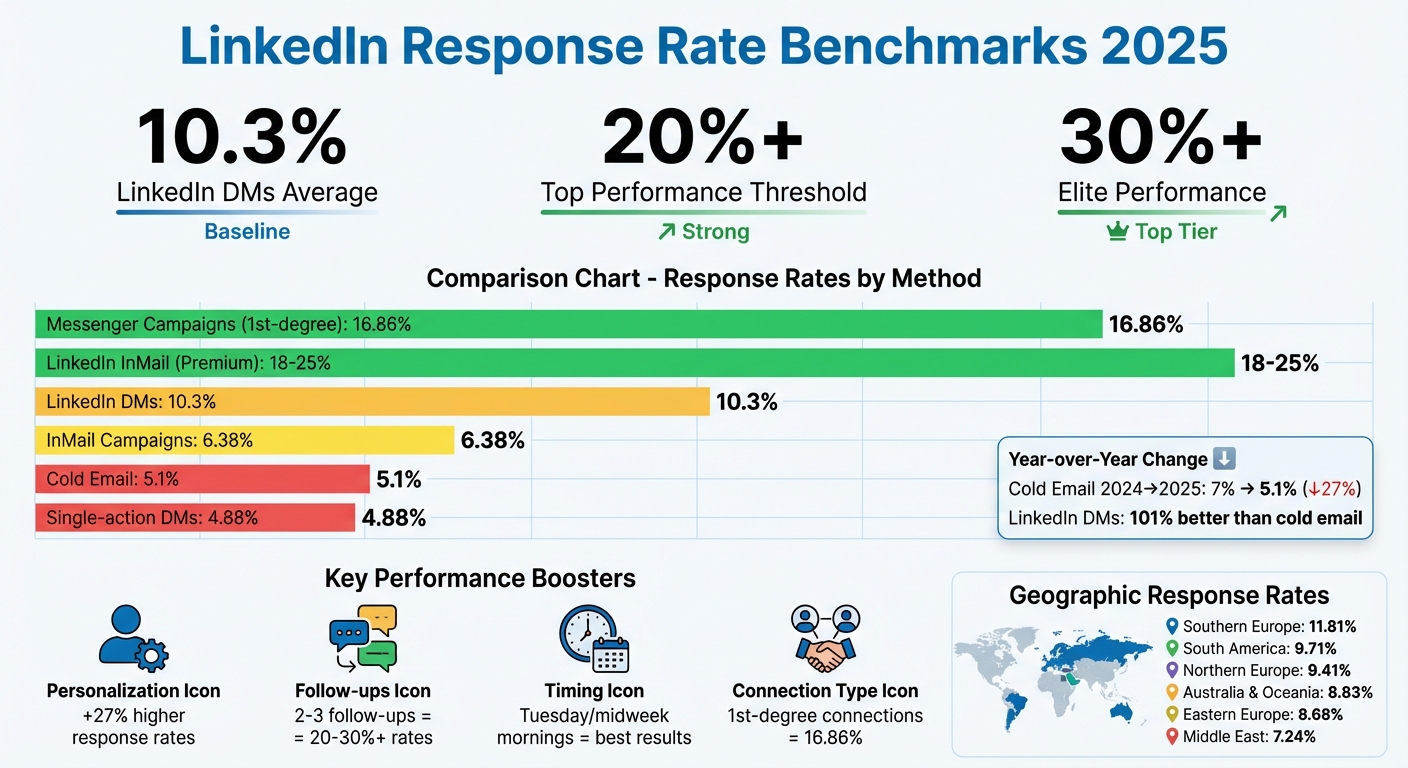
In 2025, LinkedIn direct messages achieved an average response rate of 10.3% across all outreach types [4]. This serves as a baseline for comparison. When narrowing the focus to Messenger campaigns - messages sent exclusively to first-degree connections - the response rate climbs to 16.86% [4]. This highlights the strength of leveraging existing relationships. Now, let's dive deeper into how these numbers stack up against detailed DM and InMail statistics.
InMail campaigns show varied outcomes: premium campaigns typically see 18–25% response rates, while the overall average sits at 6.38% [5][3]. However, personalization plays a significant role; well-crafted InMails can push reply rates into the 10–15% range [1].
Direct Message and InMail Response Rates
LinkedIn DMs, with their 10.3% average response rate, outperform cold emails, which average just 5.1% [4]. InMails, on the other hand, are approximately 300% more effective than cold emails, boasting 18–25% response rates compared to email's 3% average [5].
Single-action direct messages - those designed to prompt one specific action - have a 4.88% reply rate [3]. While this is lower than conversational-style messages, it still surpasses most cold email campaigns. These numbers underscore LinkedIn's advantage as a professional platform with less spam filtering, making it a more conducive space for outreach.
How Response Rates Changed from 2024 to 2025
Cold email response rates saw a sharp decline, dropping from 7% in 2024 to 5.1% in 2025 [4], a 27% year-over-year decrease. Meanwhile, LinkedIn direct messages now perform 101% better than cold emails [4]. This growing disparity reflects increasing email inbox saturation and stricter spam filters. These shifts emphasize the importance of aligning your outreach strategy with LinkedIn's current response benchmarks.
LinkedIn's professional environment and visibility of mutual connections foster a level of trust that cold emails often lack, making it a more effective outreach tool.
Response Rates by Outreach Method
Different LinkedIn outreach methods yield varying levels of success. Here's a breakdown of response rates by method:
| Outreach Method | Average Response Rate | Key Factor |
|---|---|---|
| Messenger campaigns (1st-degree connections) | 16.86% [4] | Established relationships |
| LinkedIn InMail | 18–25% [5] | Premium feature, broader reach |
| LinkedIn DMs | 10.3% [4] | Standard messaging |
| InMail campaigns | 6.38% [3] | Targeting-dependent |
| Single-action DMs | 4.88% [3] | Focused, simple request |
| Cold email | 5.1% [4] | Lacks platform context |
The data clearly shows that Messenger campaigns, which rely on existing connections, deliver the most consistent results. Meanwhile, personalized and well-targeted InMails offer the greatest potential for higher response rates.
Response Rates by Message Type and Follow-Up Sequence
How Personalization Affects Response Rates
Adding a personal touch to your LinkedIn messages can make a big difference in how people respond. For example, personalized connection requests see a 9.36% reply rate, which is 72% higher than generic ones. In some targeted campaigns, this number can climb to nearly 20% [3][6]. When it comes to InMails, strong personalization can raise reply rates from the usual 3–8% range to as high as 10–15% [1]. Even small personal touches can increase response rates by 27% [2].
Interestingly, AI-crafted first messages perform better than non-AI ones, achieving a 4.19% reply rate compared to 2.60% for non-AI messages [3]. However, overly generic outreach - whether AI-generated or not - tends to fall flat and gets ignored.
With this in mind, let’s explore how initial messages and follow-ups compare when it comes to driving engagement.
First Messages vs. Follow-Ups: What the Data Shows
While the first message lays the groundwork, follow-ups play a critical role in boosting engagement. Data shows that the first follow-up might experience a slight dip in reply rates, dropping by 0.6%, but the second follow-up makes a notable impact, increasing replies by 4.05% [7]. Adding a third follow-up provides an additional 1% boost, though the returns diminish after that point [7].
Interestingly, follow-ups written without AI tend to perform better. Non-AI follow-ups achieve a 3.91% reply rate, compared to 3.48% for those created with AI [3]. Campaigns that include 2–3 follow-ups, spaced 4–7 days apart, typically see success rates in the 20–30%+ range [7][8]. Combining this multi-step approach with personalization delivers the best results for LinkedIn outreach.
Response Rates by Industry, Location, and Timing
These external factors build on earlier insights about the importance of message personalization and follow-ups.
Response Rates Across Different Industries
The industry someone works in can significantly impact how they respond to LinkedIn outreach. For example, Legal & Professional Services see the highest engagement, with Healthcare and Retail & Consumer Goods following closely behind. On the other hand, industries with more in-person roles or seasonal hiring patterns tend to show lower response rates [9]. These differences create a foundation for understanding how engagement also varies by region.
Geographic Differences in Response Rates
Location plays a crucial role in LinkedIn engagement, just as much as industry. A 2025 study analyzing 20 million LinkedIn outreach attempts across nine regions found notable differences in reply rates. Here’s how they stacked up:
- Southern Europe: 11.81%
- South America: 9.71%
- Northern Europe: 9.41%
- Australia & Oceania: 8.83%
- Eastern Europe: 8.68%
- The Middle East: 7.24%
These variations largely reflect differences in local communication styles and business norms. For example, regions like the Middle East, with lower response rates, may benefit from culturally tailored messaging and a focus on building relationships first [3].
When to Send LinkedIn Messages for Better Response Rates
Timing is another key factor that can influence response rates. Engagement is highest early in the workweek, with Tuesday consistently standing out as the best day for outreach. Response rates tend to taper off as the weekend approaches. On a monthly scale, January, April, and July see the highest engagement, while the final quarter of the year (October through December) typically experiences the lowest activity. For the best results, aim to send messages during standard business hours (9:00 AM–5:00 PM) in the recipient's time zone.
How to Use These Benchmarks for Your LinkedIn Outreach
Comparing Your Results to 2025 Benchmarks
Start by calculating your reply rate - the percentage of people who respond to your outreach. A reply rate between 10% and 15% indicates you're on the right track. If you're hitting 20% or higher, your messaging and targeting are working well. And if you're seeing 30% or more, you're achieving outstanding results [1].
But what if you're below 10%? That’s a clear signal to reassess your approach. The good news is that even small tweaks - like adding a personal touch to your connection requests or experimenting with different send times - can make a noticeable difference.
Next, dive into the key factors that influence these reply rates.
What Affects Your LinkedIn Response Rates
Several factors play a role in determining how often people respond to your LinkedIn outreach:
- Audience targeting: Are you reaching the right people? If not, even the best message won't resonate.
- Message quality: Personalization and relevance are critical. A generic message is easy to ignore, while a tailored one grabs attention.
- Follow-up strategy: A single message rarely does the trick. Multi-touch campaigns, where you follow up thoughtfully, often yield better results.
Timing and cadence also matter. When and how often you reach out can significantly impact whether someone replies. Understanding these factors is essential, but tracking your progress is just as important.
Tracking Response Rates with EngageKit
If you're struggling with targeting or crafting high-quality messages, tools like EngageKit can help you refine your approach. EngageKit allows you to track and nurture your connections over time, creating a more effective outreach process. By organizing your prospects into targeted lists and using topic-specific searches, you can stay engaged with their content and build familiarity. This way, when you send a message, they’re more likely to recognize your name - and respond.
EngageKit also incorporates a human-in-the-loop approach, meaning you can review and approve all interactions. This ensures every engagement aligns with your strategy and feels authentic. By focusing on meaningful, consistent interactions, you set the stage for achieving - or even surpassing - the 2025 benchmarks for LinkedIn outreach.
Conclusion
The LinkedIn response benchmarks for 2025 offer a clear path to refining your outreach strategy and fostering genuine connections. With an average response rate of 10.3%, LinkedIn outreach significantly outperforms cold email, which sits at just 5.1% - more than doubling engagement and making LinkedIn the smarter choice for expanding your network and starting meaningful conversations [4].
Here are some key insights to keep in mind: Personalization is critical. Messages that mention specific achievements or shared connections see a 27% higher response rate [2]. Timing matters too. Messages sent between Tuesday and Thursday mornings, adjusted to your recipient's local time, can boost results by 8% [2]. And don't underestimate the power of persistence - most replies come after the initial message, so follow-up sequences are a must [4][1].
However, knowing these benchmarks is just the beginning. Regularly measure your performance against these standards. If your response rates fall short of the industry average, it’s a signal to revisit your targeting, messaging, or follow-up approach. On the flip side, if your results meet or exceed these benchmarks, focus on scaling what’s working.
"Automation and personalization go hand in hand. While automation is often mistaken for spam, the right strategy enhances personalization - allowing you to build genuine relationships at scale. By automating good practices, you create more meaningful connections and drive better outreach results." - Tim Bennett, Head of Product at Expandi [4]
These insights provide a roadmap for effective LinkedIn outreach in 2025. Success on the platform will belong to those who blend data-driven strategies with authentic engagement. Use these benchmarks as your compass, experiment with different tactics, and stay consistent. Whether you’re warming up leads with profile visits, keeping messages concise under 400 characters [2], or leveraging tools like EngageKit to track and nurture connections, the ultimate goal remains the same: building relationships that drive real business results.
FAQs
How does personalization impact LinkedIn response rates?
Personalization plays a key role in boosting LinkedIn response rates by making your messages more relevant and appealing to the recipient. When someone feels a message is tailored specifically to their interests or needs, they're much more inclined to reply.
Here’s a striking example: personalized messages typically see response rates of about 9.36%, compared to just 5.44% for generic ones. Investing time in crafting thoughtful, targeted outreach not only helps you stand out but also paves the way for building stronger, more meaningful connections.
When is the best time to send LinkedIn messages to boost engagement?
The most effective days to send LinkedIn messages are Monday and Tuesday, with engagement reaching its highest during the mornings from Tuesday through Thursday. These periods align with when professionals are most likely to check their messages and respond.
To get the best outcomes, prioritize sending personalized messages that feel genuine and relevant. Pair this with well-timed follow-ups to boost your chances of receiving a reply and fostering meaningful connections. Thoughtful timing and tailored communication can make a big difference.
Do follow-up messages improve LinkedIn response rates?
Yes, follow-up messages are crucial for boosting LinkedIn response rates. In fact, many replies come after the first message, which makes follow-ups a key part of building meaningful engagement. For the best results, send 2-3 follow-up messages, spacing them out over a reasonable period, and ensure each one adds something valuable to the conversation.
A consistent and considerate approach can help you build real connections and greatly improve your chances of getting a response.