10 Tips for Engaging in LinkedIn Groups for Sales
Build trust and generate B2B leads by joining the right LinkedIn Groups, sharing helpful content, messaging thoughtfully, and tracking results.

LinkedIn Groups can be a powerful tool for sales professionals to connect with potential buyers, build trust, and generate leads. Instead of relying on cold pitches, effective group participation allows you to engage in meaningful conversations, share expertise, and establish credibility. Here’s what you need to know:
Key Takeaways:
- Join the Right Groups: Focus on groups where your target audience is active, not just your peers or competitors.
- Optimize Your Profile: Make your LinkedIn profile clear, professional, and results-driven to attract interest from group members.
- Engage Consistently: Dedicate 15 minutes daily to comment, share insights, and participate in discussions.
- Provide Value in Comments: Offer solutions and insights rather than promoting your products or services.
- Share Helpful Content: Post educational and problem-solving content, avoiding overt sales pitches.
- Turn Conversations into Connections: Build relationships by interacting thoughtfully before sending connection requests.
- Use Direct Messages Wisely: Personalize messages, focus on value, and avoid rushing into pitches.
- Track and Adjust: Monitor group activity and engagement to refine your strategy.
- Follow Group Rules: Respect group guidelines to maintain a positive reputation.
- Consider Creating a Group: If no suitable group exists, create one tailored to your niche.
Why This Matters:
- 80% of B2B leads come from LinkedIn.
- Group members can send 15 free messages per month to other participants, opening doors to new connections.
- Consistent engagement can generate 3.5x more leads compared to sporadic participation.
By focusing on quality interactions, sharing solutions, and staying organized, LinkedIn Groups can become a reliable source of leads and relationships for sales professionals.
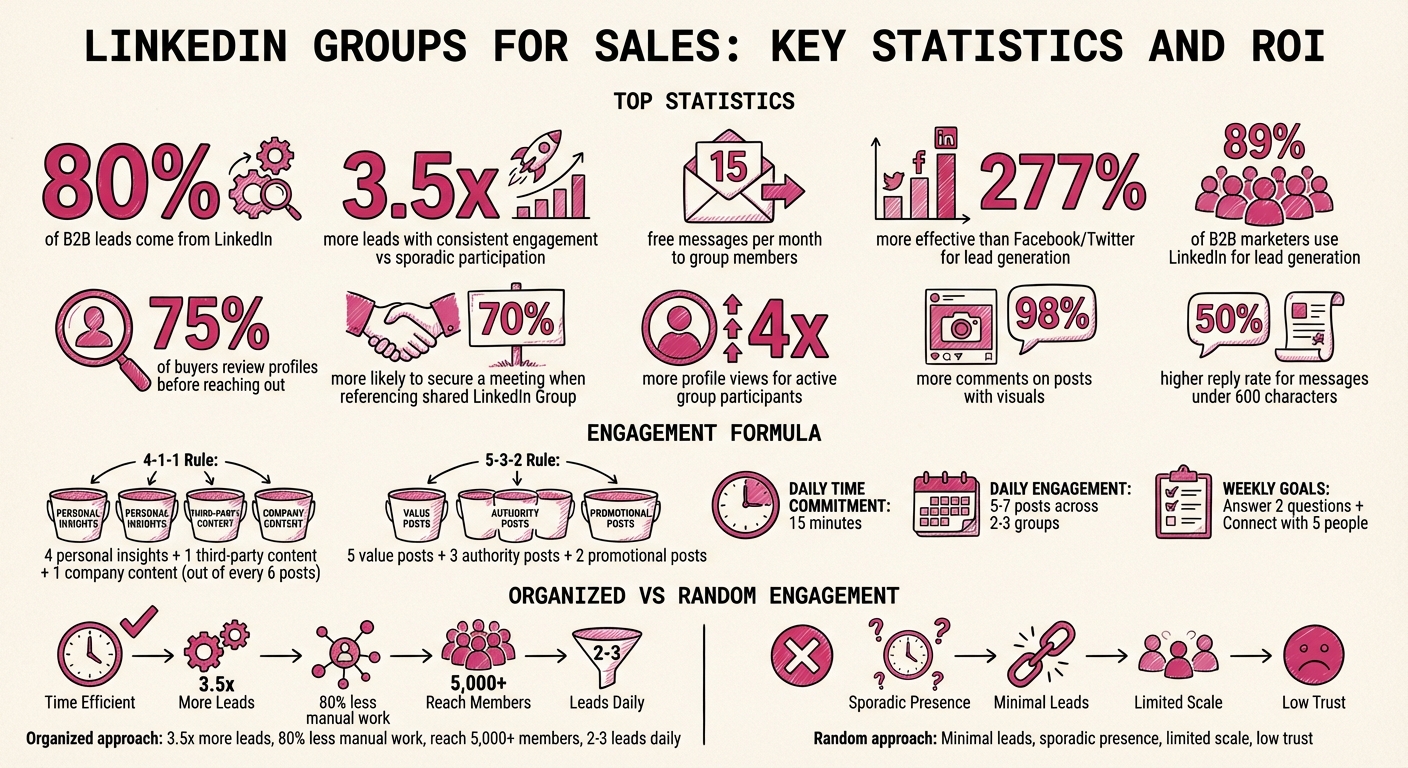
LinkedIn Groups for Sales: Key Statistics and Engagement Strategy
1. Join Groups Where Your Buyers Are Active
Focus on Buyer-Centric Groups
Many sales professionals make the mistake of joining groups that cater to their own industry, rather than communities where their potential buyers are actively participating. For example, if you're selling marketing software, it’s not helpful to join a "Marketing Software Professionals" group filled with competitors. Instead, aim for spaces where decision-makers, like marketing directors, discuss their challenges - such as "B2B Marketing Leaders" or "Growth Marketing Strategies."
A great way to find these groups is by reviewing the profiles of your top customers. Look at the communities they follow, especially those that address their biggest challenges. As Alex Hisaka from B2B Content Marketing and Copywriting puts it:
Zero in on groups discussing top issues of concern to your prospective buyers. Or, if you are targeting certain accounts, find the influential people at these companies and look on their profiles to see what groups they belong to [2].
Rather than focusing on groups that match your product category, search for keywords tied to your buyers’ pain points. For instance, if you sell project management tools, search for terms like "remote team collaboration" or "agile project leaders" instead of "project management software."
Once you’ve identified potential groups, take the time to evaluate their activity and dynamics to ensure your contributions will have an impact.
Value-Driven Engagement
When it comes to group size, bigger isn’t always better. Massive groups with 10,000+ members may seem appealing, but your voice can easily get drowned out. Groups with around 1,000 members often strike the right balance - they’re active enough to spark valuable discussions while giving you a better chance to stand out [10].
Before diving in, check the group’s recent activity. Look for daily posts that encourage genuine engagement - comments that exchange ideas and perspectives rather than just promoting products. Even smaller groups can be valuable if they include key decision-makers.
Tracking and Systematization
To make the most of your efforts, it’s important to systematize your approach. While LinkedIn allows you to join up to 100 groups, it’s more effective to focus on quality over quantity [2]. Choose two or three groups where your buyers are most active, and dedicate 15 minutes a day to sharing meaningful insights and engaging in discussions.
Don’t forget to review each group’s rules before joining. Many communities strictly prohibit promotional content or links, so tailor your approach to focus on offering helpful perspectives. Additionally, consider alumni groups from your university or previous employers - they often have established trust and present excellent networking opportunities [5].
2. Set Up Your Profile for Sales Success
Value-Driven Engagement
When you comment in a LinkedIn group, potential clients will likely check out your profile to decide if you're worth engaging with. Think of your profile as your personal landing page. In fact, research shows that 75% of buyers review profiles before reaching out [14]. This means every detail - your headline, photo, and background image - needs to immediately establish your credibility.
Start with your headline. Instead of just listing your job title, use the full 220-character limit to clearly communicate your value. A good formula to follow is: "Helping [Target Audience] achieve [Specific Result] | [Role]" [12]. For instance, "Helping B2B SaaS companies increase revenue through strategic partnerships | VP of Sales" tells prospects exactly how you can help them. Your summary should go beyond vague statements and focus on specific achievements, complete with metrics. Wrap it up with a clear call to action, including your email, so group members can easily connect with you.
Visuals are equally important because first impressions matter. Use a high-quality 400x400 headshot with a neutral background. Don’t overlook your background image either. Viveka von Rosen, CVO at Vengreso, compares leaving it blank to an unused billboard:
"like an advertising billboard that's not getting utilized" [14].
Make this space work for you by showcasing things like speaking engagements, published articles, or your contact details. A polished profile not only draws attention but also strengthens your sales conversations.
Tracking and Systematization
Your visuals and content are just the beginning. To measure how well your profile is performing, track your daily Social Selling Index (SSI). This tool evaluates your efforts in four key areas: building your brand, connecting with the right people, sharing valuable insights, and fostering relationships. Another way to boost your profile’s credibility is by asking happy clients for recommendations. These testimonials act as social proof, building trust even before you send a message [12].
When it comes to posting content, stick to the 5-3-2 rule: share five posts that provide value, three that establish your authority, and only two that promote your services. This balance ensures you’re engaging your audience without overwhelming them with sales pitches [13].
3. Provide Helpful Information in Every Comment
Value-Driven Engagement
Whenever you post in a LinkedIn group, ask yourself one simple question: Does this help someone solve a problem? Sharing insights without expecting anything in return can set you apart as a reliable resource rather than just another salesperson. Kylee Lessard, Product Marketing at LinkedIn, sums it up perfectly:
"With a selfless focus on being a helpful resource, show your unique perspective on the topics that matter most to prospective buyers." [1]
A great way to approach this is by following the 4-1-1 flip. Out of every six interactions you have in a group, aim to share your perspective four times, share third-party content once, and share your company’s content only once [2]. When sharing content, add context or ask a follow-up question to keep the conversation engaging [15][2]. Posts that include visuals tend to generate 98% more comments [1], but use images only if they genuinely enhance your point.
With these principles in mind, create a daily habit of intentional and meaningful engagement.
Tracking and Systematization
Spend 15 minutes each day engaging in 2–3 groups and commenting on 5–7 posts [2][8]. Keep track of the questions people ask about your solutions, any requests for resources, and meetings booked as a result of your activity. This will help you refine your approach and focus on the challenges group members are discussing [8][3]. If someone mentions a problem you’ve faced before, share how you tackled it and what you learned. Being genuine like this makes you more relatable to potential buyers [15].
For a more streamlined process, tools like EngageKit can help you monitor key interactions and manage your engagement routine more effectively.
4. Share Content That Helps, Not Sells
Focus on Providing Real Value
When it comes to sharing content, the goal should always be to educate and solve real problems, not to push sales. Sharing resources like industry reports, case studies, white papers, or practical tools can position you as a go-to resource in your field [3][16]. B2B content marketing expert Alex Hisaka emphasizes this point:
"LinkedIn members value true participation and authentic interactions, and tend to cool on group members who focus on self-promotion." [2]
A great strategy to follow is the 3E Rule: Educate, Engage, and Empathize. Structure your posts around a clear problem-solution format. For example, one client saw a 51% boost in web traffic after adopting this approach in LinkedIn groups [15]. To encourage conversation, wrap up your posts with an open-ended question. This tactic not only sparks meaningful discussions but also demonstrates your value to the group.
If you're just starting in a new group, avoid immediately sharing links to your products or services. Instead, focus on sharing personal experiences - both successes and challenges - that provide insights others won’t find in a basic online search. When you do share links, add your own commentary or spotlight a key takeaway to make the value clear right away [2].
Measure What Matters
Instead of chasing vanity metrics like likes or shares, pay attention to metrics that reflect genuine value, such as resource requests or questions related to solutions you’ve shared. Tools like Google Alerts can help you stay on top of relevant industry topics, while platforms like EngageKit can streamline the process by identifying which posts and topics generate the most meaningful engagement with your audience.
Koka Sexton offers a simple but powerful reminder:
"If more than half of your posts are purely informational, people see you as genuinely helpful and will respond positively to you." [6]
5. Convert Group Conversations Into Connections
Value-Driven Engagement
Once you've built credibility, the next step is turning group discussions into meaningful connections. The key here is to engage thoughtfully - don’t rush the process. As mentioned earlier, trust is your gateway to attracting prospects within group settings.
Start by interacting with prospects' posts before sending connection requests. Look for buying signals like mentions of major projects, requests for recommendations, or discussions about solving specific problems [2]. When reaching out, personalize your message by referencing something specific they’ve shared in the group. This shows you’re genuinely interested in their insights. Afterward, keep track of these interactions to ensure you follow up effectively. Organizing these steps helps lay the foundation for long-term relationships.
Tracking and Systematization
LinkedIn gives you 15 free direct messages per month to fellow group members across all the groups you’ve joined [1]. This is a valuable tool, but it’s only effective if you stay organized. Log each interaction, noting key topics discussed and when to follow up. Whether you use a CRM, a simple spreadsheet, or tools like EngageKit, having a system in place makes managing these connections much easier.
When you engage consistently, prospects are more likely to welcome your private messages because they’re already familiar with your contributions. These connections naturally open the door to genuine sales conversations. As Saurav Gupta from SalesRobot puts it:
"Your #1 goal is to build real relationships. Once you've done that, #2 goal, that is lead generation, will follow." [8]
6. Send Direct Messages the Right Way
Focus on Meaningful Engagement
Once you've established a presence in your groups, direct messages become a powerful way to build stronger connections with potential buyers. But here's the key: start with authentic conversations, not a sales pitch. LinkedIn allows you 15 free messages per month to other group members across all groups combined [1].
To make your messages count, try the PVC method: personalize your message, offer value, and end with a soft call to action [14]. For instance, instead of jumping straight to "I'd love to schedule a call", ask something like, "What’s your biggest challenge with [specific topic they mentioned]?" This sparks a genuine conversation without putting them on the defensive. And here's a pro tip: keep your messages under 600 characters - this boosts your chances of getting a reply by 50% [18].
Once you've nailed your messaging, the next step is to stay organized and track your outreach.
Stay Organized and Track Your Outreach
Crafting the perfect message is only half the battle - tracking your conversations is what ensures long-term success. Without a system, those 15 monthly messages won't deliver much impact. Keep a record of every interaction: what you talked about, when you reached out, and when to follow up. Whether you use a simple spreadsheet, a CRM like HubSpot or Salesforce, or tools like EngageKit, staying organized prevents missed opportunities.
To keep your account safe, limit yourself to sending about 10 messages per day [19]. And when it comes to follow-ups, wait at least 24 hours before reaching out again. Always provide fresh insights or value in your follow-ups - don’t just send a generic "checking in" message [19].
7. Monitor Your Results and Adjust
Monitor Engagement Quality
Take a close look at which groups are generating meaningful engagement. Start by evaluating your connection acceptance rate - if it’s low, it could mean you’re targeting the wrong groups [12]. And don’t be fooled by group size. As Sarah Socha from LinkedIn Pulse explains:
The size of the group doesn't always correlate with the quality of leads you can generate [3].
If you notice a group is largely inactive, shift your efforts elsewhere. Instead of spending time creating content for a group with little activity, consider using the member list for direct, personalized outreach. These metrics will guide you in refining your engagement strategy.
Value-Driven Engagement
Focus on metrics that truly reflect interest. Track things like the number of questions about your offerings, requests for resources, or meetings booked as a result of your group interactions [8][12]. If your posts linking to sales content aren’t gaining traction, switch gears. Share unique insights or credible third-party reports instead. You might also try the 4-1-1 formula: for every original piece of content you post, share four curated pieces that provide value [2].
Pay attention to what sparks interest. Identify which insights resonate most with your audience and tailor your outreach to address their current challenges [3][1]. This approach not only builds trust but ensures you stay top of mind when prospects are ready to make decisions [2][9].
Tracking and Systematization
Use these insights to consistently track your group activities. Dedicate just 15 minutes a day to review posts, respond to comments, and engage with members. A little consistency can go a long way [2].
To stay organized, use simple tools to monitor what’s working. Platforms like EngageKit can help you track engagement through targeted lists and topic searches, making it easier to see which connections are progressing and which ones need a different approach. Experiment with different messaging hooks, keep what works, and quickly adjust what doesn’t [12].
How To Use LinkedIn Groups for Lead Generation and Attract Your Ideal Client
8. Follow Group Guidelines and Norms
Every LinkedIn group has its own set of rules and a unique vibe. If you ignore these, you risk being seen as a spammer - and that's one of the quickest ways to drive people away from a group [9]. Before joining, take a moment to read the group description and rules. This step helps you understand what’s acceptable and sets the tone for respectful and meaningful interactions.
Once you're in, introduce yourself and explain why you’ve joined the group. Most groups discourage over-the-top self-promotion or recycling the same content repeatedly [9][2].
A great way to contribute is by following the 4‑1‑1 engagement formula: out of every six posts, share four personal insights, one piece of third-party content, and just one piece of company-related content [2]. This balanced approach helps establish you as a valuable and trustworthy member of the group. Similarly, aim to follow the 50% rule - make sure at least half of the links you share lead to external resources [6].
When reaching out to someone, take the time to build a connection first. Whether it’s through a thoughtful comment or a genuine compliment, avoid jumping straight into a sales pitch. Coming on too strong can make you look spammy [6]. As Alex Hisaka from LinkedIn wisely notes:
"Being social far outweighs selling when it comes to succeeding as a modern sales professional." [2]
Always maintain a polite and respectful tone in your interactions. LinkedIn’s Professional Community Policies emphasize professionalism and discourage argumentative or hostile behavior [9]. Think of groups as a give-and-take environment - offering help while also seeking it fosters trust and credibility over time [2].
9. Know When to Create Your Own Group
Sometimes, the perfect LinkedIn group for your sales strategy simply doesn’t exist - so why not create it yourself? With over 2 million active groups on the platform, it’s possible that none address your specific niche or tackle the unique challenges your buyers face. Building your own group allows you to fill that gap and establish a space that aligns perfectly with your goals [1][5]. Plus, it’s a natural extension of the trust-building and authority-setting strategies we’ve discussed earlier.
Another reason to start your own group? Many existing communities have strict rules that limit sharing resources, such as banning links or curbing certain types of discussions. As Pulsion Marketing aptly puts it:
"If you're not finding enough groups that fit the bill, why not create your own? You can build your own group in your target industry and set the rules you want." [10]
Owning the group comes with perks, too. You can send free weekly messages to members [10] and position yourself as a go-to expert in your field [4].
Focus on Buyer-Centric Groups
When launching your group, start small and strategic. Invite an initial group of members who can help spark meaningful conversations and set the standard for quality interactions. Carefully review each profile before approving new members to ensure your group stays relevant and valuable [9]. A great example of this approach is the Content Marketing Institute’s private, listed group. With over 150,000 members as of December 2025 and growing steadily, they maintain quality by requiring admin approval for every post and banning promotions or irrelevant links [17].
Opt for a "Private (Listed)" group setting. This keeps your group visible in search results while giving you control over who can join [17].
Value-Driven Engagement
Engagement is the heart of a thriving group. Ask members directly what they’re looking for, and plan a content schedule for the first few weeks to keep the momentum going [9]. For instance, Search Engine Land’s group, which boasts over 137,000 members, uses the #QuestionForTheGroup tag to encourage expert insights and peer feedback [17]. Acknowledge contributions by liking and commenting on posts, and tag experts to add credibility and fuel deeper conversations [9]. Don’t forget - posts with images get 98% more comments than plain text posts, so incorporate visuals to boost interaction [1].
Once your group is active, focus on keeping its operations smooth and efficient.
Tracking and Systematization
Managing a LinkedIn group can be demanding, so avoid burnout by assigning multiple managers to share responsibilities [9]. Stick to a regular posting schedule to ensure your group remains lively and doesn’t fade into inactivity [9]. Set clear rules about acceptable behavior and group culture from the beginning. Spam is a major reason people leave groups, so remove it promptly to maintain a positive experience for members [9]. This level of moderation is what separates successful, thriving communities from those that fizzle out.
To make management easier, consider tools like EngageKit. Its human-in-the-loop system can help you approve interactions and track connections using targeted lists tailored to your audience. This way, you can stay organized while focusing on what matters most - building a vibrant, engaged community.
10. Build a Routine for Group Activity
When it comes to LinkedIn Groups, consistency matters far more than intensity. Regular engagement builds trust and credibility over time. As Alex Hisaka, a B2B Content Marketing and Copywriting expert and former LinkedIn team member, puts it:
"Social selling hinges on social interactions. You won't develop trust if you just drop in to socialize occasionally. We trust those with a steady presence, those we can rely on to show up and contribute on a regular basis." [2]
Carve out 15 to 45 minutes each day to engage with LinkedIn Groups [2][11]. This small, consistent effort can lead to what Alexander Low, Managing Director at DCM Insights, describes as "micro-moments of influence":
"If you show up every day on social media here with intention and engage with people by liking or commenting on their posts, you are creating micro-moments of influence." [11]
Focus your efforts on two or three groups that are most relevant to your target audience [2]. Use the 4-1-1 formula to strike a balance in your contributions - share valuable content, engage meaningfully, and avoid self-promotion overload. This structured approach not only strengthens your presence but also complements your broader strategy.
To maintain momentum, set weekly goals. For example, aim to answer at least two questions in your groups and connect with five relevant individuals each week [7]. Track which activities generate the most profile views and connection requests, then refine your approach based on those insights. Statistics show that sales professionals who actively participate in groups receive four times as many profile views as those who don’t. Plus, you're 70% more likely to secure a meeting with a prospect if you can reference a shared LinkedIn Group during outreach [20].
To streamline your routine, leverage simple tools. Google Alerts can help you stay informed about buyer pain points so you can join relevant discussions quickly [6][11]. The LinkedIn mobile app lets you stay connected while on the move [1]. Platforms like EngageKit can help you manage interactions and track connections, keeping your efforts organized and effective. By sticking to this routine, you'll foster genuine relationships while staying aligned with your broader social selling goals.
Comparison Table
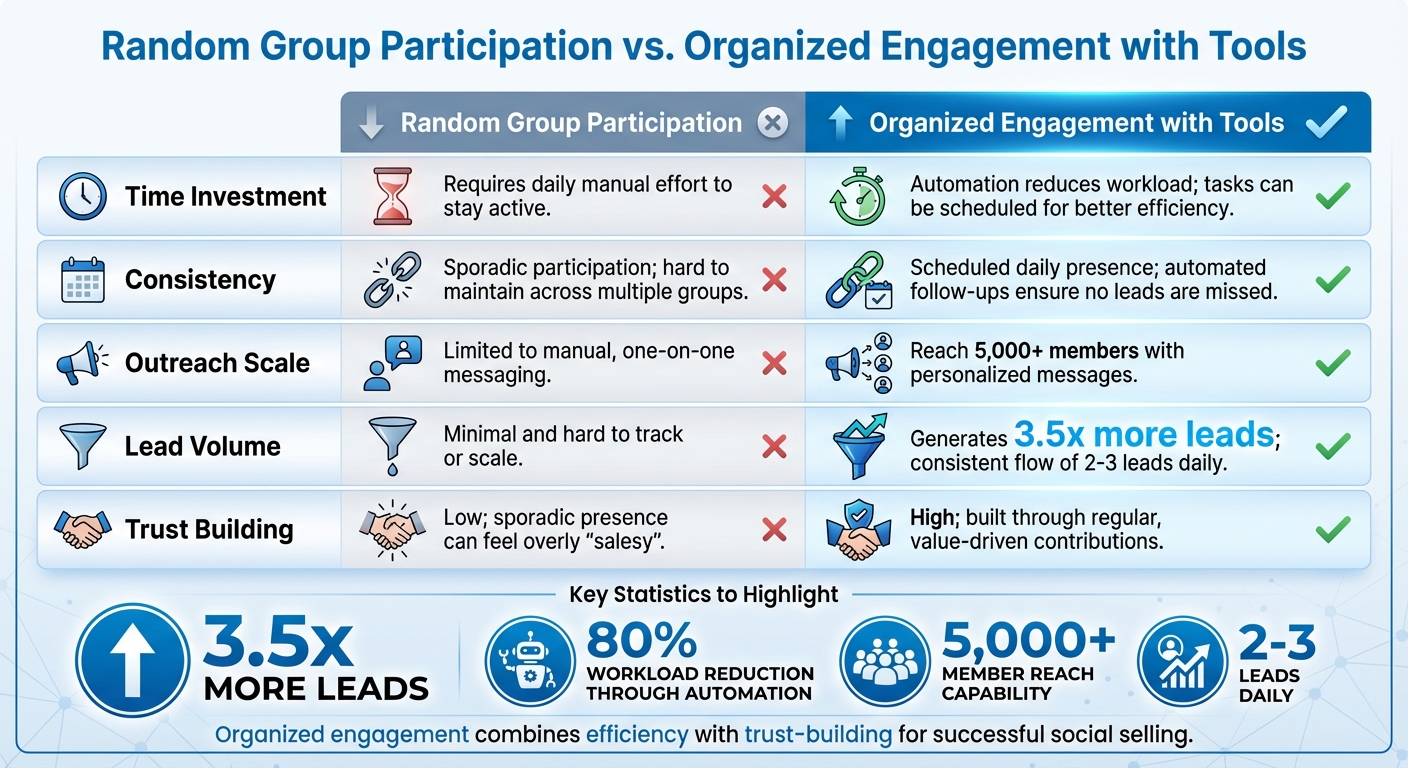
Random vs Organized LinkedIn Group Engagement Strategy Comparison
The choice between random group participation and a more organized engagement strategy comes down to efficiency, consistency, and measurable results. Without a structured system, manual engagement is limited by messaging quotas and demands a significant daily time investment, making it tough to scale effectively.
A structured approach flips the script. Using tools to track engagement and manage connections can automate up to 80% of the manual workload [8]. This means you can focus on activities that directly close deals. The numbers back this up: organized engagement generates 3.5 times more leads while saving hours on repetitive tasks [16]. It’s a clear case for why a systematized strategy ensures not only consistent visibility but also delivers measurable business results.
Here’s a side-by-side comparison of the two approaches:
| Feature | Random Group Participation | Organized Engagement with Tools |
|---|---|---|
| Time Investment | Requires daily manual effort to stay active | Automation reduces workload; tasks can be scheduled for better efficiency [8] |
| Consistency | Sporadic participation; hard to maintain across multiple groups [8] | Scheduled daily presence; automated follow-ups ensure no leads are missed [2] |
| Outreach Scale | Limited to manual, one-on-one messaging | Reach 5,000+ members with personalized messages [8] |
| Lead Volume | Minimal and hard to track or scale [2] | Generates 3.5 times more leads [16]; consistent flow of 2-3 leads daily [8] |
| Trust Building | Low; sporadic presence can feel overly "salesy" | High; built through regular, value-driven contributions [2] |
This systematic approach not only boosts lead generation but also strengthens the trust and authority needed for effective LinkedIn engagement. Consistency is particularly critical for sales success. As Alex Hisaka from LinkedIn explains:
"We trust those with a steady presence, those we can rely on to show up and contribute on a regular basis" [2].
Manual engagement often falls short of delivering the reliability needed for strong sales outcomes. Tools like EngageKit help close this gap by allowing you to approve engagements and track connections through targeted lists. This ensures your presence stays both dependable and authentic. By adopting an organized engagement strategy, you combine efficiency with trust-building - two essential ingredients for successful social selling.
Conclusion
LinkedIn Groups thrive on consistent and genuine participation. Those who dedicate time to showing up regularly, sharing meaningful insights, and earning trust before making a pitch often find the most success.
The tricky part? Juggling this steady engagement with the demands of your sales workload. Managing interactions across several groups can feel overwhelming, especially when trying to keep everything organized. That’s why building a routine of authentic engagement is so important - it helps you stay on track without losing sight of your goals.
This is where tools like EngageKit can make a difference. It helps streamline your interactions while keeping them personal. You stay in control by approving all activities, and the tool tracks your connections through targeted lists and niche-specific topic searches. The result? You maintain a reliable presence that fosters trust, all while freeing up time to focus on closing deals.
And the numbers back this up: 89% of B2B marketers rely on LinkedIn for lead generation [21], and the platform is 277% more effective than Facebook and Twitter for generating leads [21]. But these stats only translate into success if you're actively engaging in the right groups with the right strategy.
So, carve out just 15 minutes a day to participate in two or three active groups. Share thoughtful insights, build meaningful relationships, and let the sales come naturally. With this approach, you’ll position yourself as a trusted resource - not just another salesperson.
FAQs
How do I find the best LinkedIn groups to support my sales efforts?
To discover LinkedIn groups that align with your sales strategy, start by defining your ideal customer. Consider their industry, job roles, company size, and the specific challenges your product or service addresses. Then, use LinkedIn’s search bar to find groups using relevant keywords like “SaaS sales leaders” or “healthcare decision-makers.”
When narrowing down your options, focus on these key factors:
- Audience relevance: Read the group description to confirm that its members match your target audience.
- Group size and engagement: Aim for groups with a few hundred to a few thousand active members. Oversized groups can dilute your efforts, while very small ones may lack meaningful engagement.
- Quality of discussions: Look for groups where members actively share ideas, ask questions, and participate in thoughtful conversations.
After joining the right groups, tools like EngageKit can simplify the process by tracking activity, managing your interactions, and identifying which groups deliver the best leads. This way, you can focus your energy on communities that genuinely contribute to your sales objectives.
What are the best ways to engage with potential clients in LinkedIn Groups?
To connect with potential clients in LinkedIn Groups, focus on forming real relationships instead of jumping straight into sales. Begin by joining groups that align with your industry or niche, especially those where your target audience is active. Before diving in, take a moment to read the group’s description and rules to ensure your contributions fit the community’s vibe.
Dedicate 10–15 minutes each day to engaging with group posts. This could mean liking posts, leaving thoughtful comments, or sharing insights that add value to the discussion. Skip the hard-sell tactics - nobody likes a sales pitch disguised as a comment. Instead, offer helpful advice, share relevant articles, or ask engaging questions to spark genuine conversations. When commenting, make it personal by referencing the original post to show you’re paying attention.
After building some rapport, take the next step by sending a personalized connection request or message that refers back to your group interaction. Tools like EngageKit can help you keep track of these connections while ensuring each interaction feels intentional and authentic. This strategy helps you earn trust, establish yourself as an expert, and lay the groundwork for future business opportunities.
What’s the best way to measure the success of my LinkedIn group activity?
To evaluate the success of your LinkedIn group efforts, start by keeping an eye on key engagement metrics like post views, likes, comments, and shares. These numbers tell you how well your content resonates with the group. Beyond that, observe how these interactions lead to tangible outcomes like new connections, profile visits, or direct inquiries. For a deeper dive, calculate metrics like the engagement rate (total interactions ÷ total impressions × 100) to measure overall activity, and the participation rate (comments ÷ posts) to see how involved members are in discussions.
If you're using tools such as EngageKit, you can track every approved interaction and tie it back to specific campaigns. This makes it easier to figure out which efforts are bringing in qualified leads or inbound opportunities. Pair this data with LinkedIn’s built-in analytics to monitor how many members are joining your group and how many are moving into your sales funnel. Over time, you can also calculate a lead-to-opportunity conversion rate to measure how your group contributes to revenue growth.
To keep your strategy sharp, review engagement metrics on a weekly basis and take a closer look at conversion-focused data each month. Use these insights to tweak your approach, prioritizing the activities that generate the most valuable interactions. If you notice steady growth in engagement, meaningful connections, and sales opportunities, it’s a clear sign that your LinkedIn group strategy is paying off.